
The Law of Super Asymmetry: Why the Best Businesses Become Impossible to Compare.

Listen to the audio version of this blog post.
Watch a video summary of this post.
One of the biggest myths in business is that success comes from competing better than everyone else. It’s advice we’ve all heard countless times. Work harder. Offer better service. Improve quality. Lower your prices. Spend more on marketing. Hire better people. Outperform the competition.
On the surface, it sounds sensible.
But the more I’ve worked with businesses over the years, the more I’ve come to believe that it’s fundamentally the wrong objective. If you’re competing on exactly the same terms as everyone else, you’ve already accepted the rules of a game that someone else can play just as well as you can.
In fact, I don’t believe businesses should be striving for a level playing field at all. I believe they should be trying to escape it. Think about what happens in most industries.
- A restaurant introduces an online booking system. Within months, every restaurant has one.
- A builder starts posting before-and-after photographs on social media. Soon every builder is doing exactly the same.
- One accountant begins offering fixed-fee packages. Before long, fixed fees become the industry norm.
- One retailer offers free next-day delivery. It doesn’t take long before customers expect everyone else to do it too.
Every innovation that creates a competitive advantage is gradually copied until it no longer provides an advantage at all. What started as a point of differentiation becomes the new minimum standard.
I’ve seen exactly the same thing happen with artificial intelligence.
Only a short time ago, simply saying your business used AI made you appear innovative. Today, almost every software company claims to be AI-powered. Within a few years, AI won’t be a differentiator at all. It will simply be another business utility, just like email, accounting software or a website.
This is what I call business symmetry. Businesses naturally drift towards becoming more alike.
- They sell similar products.
- They promise similar benefits.
- They use similar technology.
- They adopt similar pricing models.
- They even use remarkably similar marketing messages.
As this symmetry increases, customers find it harder to distinguish one business from another. When that happens, they fall back on the simplest comparison they can make.
Price.
We’ve all heard someone say, “I’ll just get three quotes.” That single sentence tells you something important. It tells you the customer sees very little meaningful difference between the businesses they’re considering.
The moment a customer starts comparing quotations side by side, you’ve entered a symmetrical market. In that environment, every business is fighting on the same battlefield. Margins become thinner, marketing becomes more expensive, and winning often comes down to who is prepared to sacrifice the most profit.
I don’t find that a particularly attractive strategy. I’d much rather build a business that customers struggle to compare in the first place.
- When somebody buys a Ferrari, they don’t usually compare it against a family hatchback because they’re solving a different problem and buying for different reasons.
- When a business hires a world-renowned specialist, they rarely ask them to match the hourly rate of a newly qualified consultant.
- When someone books a Michelin-starred restaurant, they aren’t comparing it with the local takeaway.
In each case, competition still exists, but it exists on entirely different terms. The businesses have created enough difference that the normal rules of comparison no longer apply. That’s what I’ve come to believe is the real objective of strategy. Not becoming marginally better than your competitors.
Becoming sufficiently different that competing on a level playing field becomes increasingly irrelevant. This is what I call The Law of Super Asymmetry (In a nod to Big Bang Theory).
1. The Problem with Symmetry.
One of the fascinating things about business is that markets naturally drift towards symmetry.
Very few business owners set out to become identical to their competitors. In fact, most genuinely believe they’re different. Yet, over time, something remarkable happens. They begin responding to the same market forces, copying the same successful ideas and adopting the same technologies until they become increasingly difficult to distinguish from one another.
It isn’t because they’re uncreative.
It’s because symmetry is the path of least resistance.
Imagine one business starts offering free delivery. Customers love it. Before long, every competitor feels they have no choice but to offer free delivery too.
A software company introduces monthly subscriptions instead of annual licences. Customers embrace the flexibility, and within a few years the entire industry has moved to subscription pricing.
One estate agent begins producing high-quality property videos. Soon every estate agent is doing exactly the same.
The same thing happens with websites, social media, online booking systems, customer reviews, fixed-fee pricing, AI-powered chatbots and countless other innovations. Every competitive advantage is gradually copied until it becomes an expected part of doing business.
Yesterday’s innovation becomes today’s expectation.
That’s the problem.
Businesses often mistake adopting best practice for creating competitive advantage. In reality, best practice rarely remains an advantage for long because everyone eventually adopts it.
This creates what I call business symmetry.
Businesses become increasingly alike across almost every dimension:
- They sell similar products.
- They promise similar benefits.
- They use similar suppliers.
- They adopt similar technologies.
- They recruit people with similar skills.
- They market themselves in similar ways.
- They even begin using remarkably similar language.
Browse almost any industry and you’ll see websites claiming to provide “excellent customer service”, “competitive prices”, “quality workmanship” and “professional advice”. These statements are so common they’ve become virtually meaningless.
The irony is that businesses often believe these similarities reduce risk. “If everyone else is doing it, it must be right.” From an operational perspective, that may be true. From a strategic perspective, it’s incredibly dangerous.
Every time you become more like your competitors, you give customers one less reason to choose you. Eventually, customers stop seeing meaningful differences altogether. When that happens, they revert to the easiest form of comparison they have.
Price.
This is why so many industries find themselves trapped in endless price competition. Not because customers are obsessed with buying the cheapest product. But because businesses have failed to create enough meaningful difference for customers to justify paying more.
Price isn’t usually the cause of commoditisation. It’s the consequence of symmetry.
This explains why businesses often feel they’re working harder than ever while making less money. They improve efficiency, refine processes, invest in marketing and introduce new technology, yet their margins continue to shrink.
- They’re becoming better businesses.
- They’re just becoming better in exactly the same way as everyone else.
The uncomfortable truth is that excellence alone isn’t enough. If your excellence is easily copied, it simply raises the standard for the entire market. The businesses that consistently achieve exceptional profits don’t merely improve existing models. They escape them.
Instead of asking, “How can we do this better than our competitors?” They ask a far more powerful question: “How can we make this comparison impossible?”
That, I believe, is where Super Asymmetry begins.
2. Competition Is the Consequence of Symmetry.
We’ve been taught to believe that competition is simply a fact of business. Every business textbook talks about analysing competitors, outperforming competitors and gaining competitive advantage. We accept competition as though it’s a law of nature.
But over the years I’ve started asking a different question.
- What if competition isn’t the problem?
- What if symmetry is the problem, and competition is simply the consequence?
Think about the businesses that compete most aggressively.
- Petrol stations.
- Supermarkets.
- Insurance companies.
- Utility providers.
- Airlines.
- Mobile phone contracts.
In these markets, customers often struggle to identify meaningful differences between providers. One litre of fuel is much the same as another. Electricity is electricity. A mobile phone contract can look almost identical regardless of who provides it.
Because customers perceive very little difference, they compare the only things they can easily compare.
- Price.
- Promotions.
- Special offers.
- Cashback.
- Interest-free periods.
The businesses aren’t necessarily competing because they want to. They’re competing because they’ve become symmetrical. Now compare that with businesses that have deliberately created asymmetry.
- People rarely negotiate with their favourite restaurant.
- They don’t ask a sought-after architect to match the price of a newly qualified designer.
- Someone buying a luxury watch isn’t usually comparing it with a budget alternative.
When a business owner hires the consultant they believe can genuinely transform their company, they’re far less interested in whether someone else is 20% cheaper. The comparison has changed. In many cases, it has disappeared altogether. The more distinctive a business becomes, the less direct competition matters. That’s because customers stop asking,
“Who’s cheapest?” and start asking, “Who’s right for me?”
That is a fundamentally different buying decision. One is transactional. The other is relational. This has significant implications for profitability.
When businesses compete in symmetrical markets, every improvement tends to benefit the entire industry. One business introduces a new feature, and everyone else follows. One business cuts prices, and competitors respond. One launches a successful marketing campaign, and similar campaigns soon appear elsewhere.
The advantage is temporary because the market quickly returns to symmetry.
This is why so many businesses feel trapped in a cycle of constant catch-up. They’re always reacting to competitors instead of creating distance between themselves and the market. I’ve seen this countless times.
- A business owner tells me they’re worried because a competitor has redesigned their website.
- A rival has started posting daily on LinkedIn.
- Someone else has introduced AI into their customer service.
- Another business has lowered its prices.
Their instinct is to respond in kind. But if everyone copies everyone else, nothing really changes. The entire market simply becomes more symmetrical. That’s why I believe one of the most dangerous strategic questions in business is:
“What are our competitors doing?”
There’s nothing wrong with understanding your competitors. The danger comes when they become your benchmark. If your strategy is built around matching your competitors, you’re guaranteeing that you’ll become increasingly similar to them.
Instead, I think businesses should ask a completely different question:
“What could we do that would make comparison increasingly difficult?”
That shifts your thinking from imitation to innovation. From reacting to leading. From competing harder to becoming less comparable. Ironically, the businesses that appear to have the least competition often haven’t eliminated competitors at all.
They’ve simply made those competitors less relevant. That’s a very different objective. Competition, therefore, isn’t something I try to win. It’s something I try to escape.
- Not by ignoring the market.
- Not by pretending competitors don’t exist.
But by creating enough meaningful asymmetry that customers stop viewing my business as just another option on a comparison list. Because once a customer stops comparing you with everyone else, you’ve stopped competing on a level playing field. And that’s where real strategic advantage begins.
One of the best examples of this comes from the British motor industry during the 1960s and 1970s.
For decades, Britain’s major car manufacturers competed fiercely with one another. Companies such as British Leyland, Austin, Morris, Triumph and Rover constantly compared themselves against their domestic rivals. They fought over market share, refined existing models and focused on outperforming one another within the UK market.
In many ways, they became increasingly symmetrical.
Their products evolved in similar ways. Their manufacturing practices shared many of the same strengths—and weaknesses. Their assumptions about what customers wanted were remarkably alike. They were playing the same game, on the same pitch, against the same opponents.
- The problem wasn’t that they were competing.
- The problem was who they were competing against.
While British manufacturers were benchmarking themselves against one another, Japanese manufacturers such as Toyota, Honda and Nissan were playing an entirely different game. They invested heavily in manufacturing quality, reliability, fuel efficiency and continuous improvement. Rather than trying to beat British companies at their own game, they created a different game altogether.
This was asymmetry in action.
When the oil crises of the 1970s increased demand for smaller, more fuel-efficient and more reliable cars, Japanese manufacturers weren’t simply marginally better. They offered something the established British industry had largely failed to anticipate.
The British manufacturers suddenly discovered they weren’t competing against slightly different versions of themselves. They were competing against businesses built on fundamentally different principles. By the time many recognised the threat, the gap had become extremely difficult to close.
The lesson extends far beyond the motor industry.
Whenever businesses focus exclusively on matching the competitors they already know, they risk becoming increasingly similar to one another. In doing so, they can become blind to organisations outside their traditional competitive landscape that are creating entirely new forms of value.
History shows that industries are rarely transformed by the businesses that become the best at playing the existing game. They’re transformed by the businesses that change the rules of the game completely. That’s why I believe one of the most dangerous questions a leadership team can ask is:
“What are our competitors doing?”
A far better question is:
“Who isn’t our competitor today, but could redefine our industry tomorrow?”
Because the greatest competitive threats often don’t arrive as better versions of existing competitors. They arrive as asymmetrical competitors that make the old rules obsolete.
3. The Law of Super Asymmetry.
Everything I’ve discussed so far leads me to a simple conclusion.
For decades we’ve been taught that the purpose of strategy is to build a competitive advantage. We analyse our competitors, benchmark our performance, identify best practice and search for ways to outperform businesses that look remarkably similar to our own.
But what if we’ve misunderstood the objective altogether? What if the purpose of strategy isn’t to become better at competing? What if the purpose of strategy is to become progressively harder to compete against? That distinction may appear subtle, but I believe it changes everything.
It has led me to formulate what I call The Law of Super Asymmetry.
“The objective of business is not to compete more effectively on a level playing field. It is to create such profound asymmetry that meaningful competition becomes increasingly irrelevant.”
Notice that I haven’t said competition disappears. Competition will always exist. New businesses will emerge. Existing competitors will improve. Markets will evolve, and customer expectations will continue to rise.
The goal isn’t to eliminate competition. The goal is to become so distinctive, so valuable, and so difficult to replicate that customers no longer see you as simply another option among many. At that point, the nature of competition changes.
- Customers stop comparing you purely on price.
- Competitors find it increasingly difficult to imitate your strengths.
Your business begins to define its own market rather than merely participate in someone else’s. This is what I mean by Super Asymmetry. Importantly, this isn’t an on-or-off switch. No business wakes up one morning and suddenly becomes asymmetrical. It is a continuum.
- Every strategic decision either moves your business towards greater symmetry or greater asymmetry.
- Every time you copy a competitor without adding anything unique, you move towards symmetry.
- Every time you reduce your business to competing on price, you move towards symmetry.
- Every time your products, services, marketing and customer experience become more difficult to distinguish from everyone else’s, you move towards symmetry.
Equally, every time you create something genuinely valuable that competitors struggle to replicate, you move towards asymmetry.
- Every time you deepen customer trust.
- Every time you develop proprietary knowledge.
- Every time you strengthen your brand.
- Every time you improve your systems in ways that reinforce one another.
You increase the distance between your business and everyone else. Over time, those small differences compound. Eventually they become strategically significant. This is perhaps the most important insight of all.
Super Asymmetry is rarely created by one extraordinary advantage.
It’s created by the accumulation of many reinforcing asymmetries that, together, become extremely difficult to copy. A trusted brand reinforces premium pricing. Premium pricing funds better people. Better people create better customer experiences. Better customer experiences generate stronger referrals. More customers create more data. More data leads to better decisions. Better decisions strengthen the brand even further.
Each advantage amplifies the next.
The business becomes more than the sum of its individual strengths. This also explains why industries that appear stable can suddenly be transformed. When businesses within an industry become increasingly similar, they often believe they’re becoming more competitive.
In reality, they may simply be becoming more vulnerable.
The greater the symmetry within an industry, the greater its vulnerability to asymmetrical disruption.
History demonstrates this repeatedly. Entire industries become so focused on outperforming familiar competitors that they fail to notice someone approaching from an entirely different direction with a completely different model. By the time they recognise the threat, the rules of competition have already changed.
That’s why I don’t believe businesses should ask: “How can we compete more effectively?”
I believe they should ask: “How can we become progressively less comparable?”
Because the businesses that create the greatest long-term value aren’t necessarily those that compete the hardest. They’re the ones that make meaningful comparison increasingly impossible.
That is the essence of The Law of Super Asymmetry.
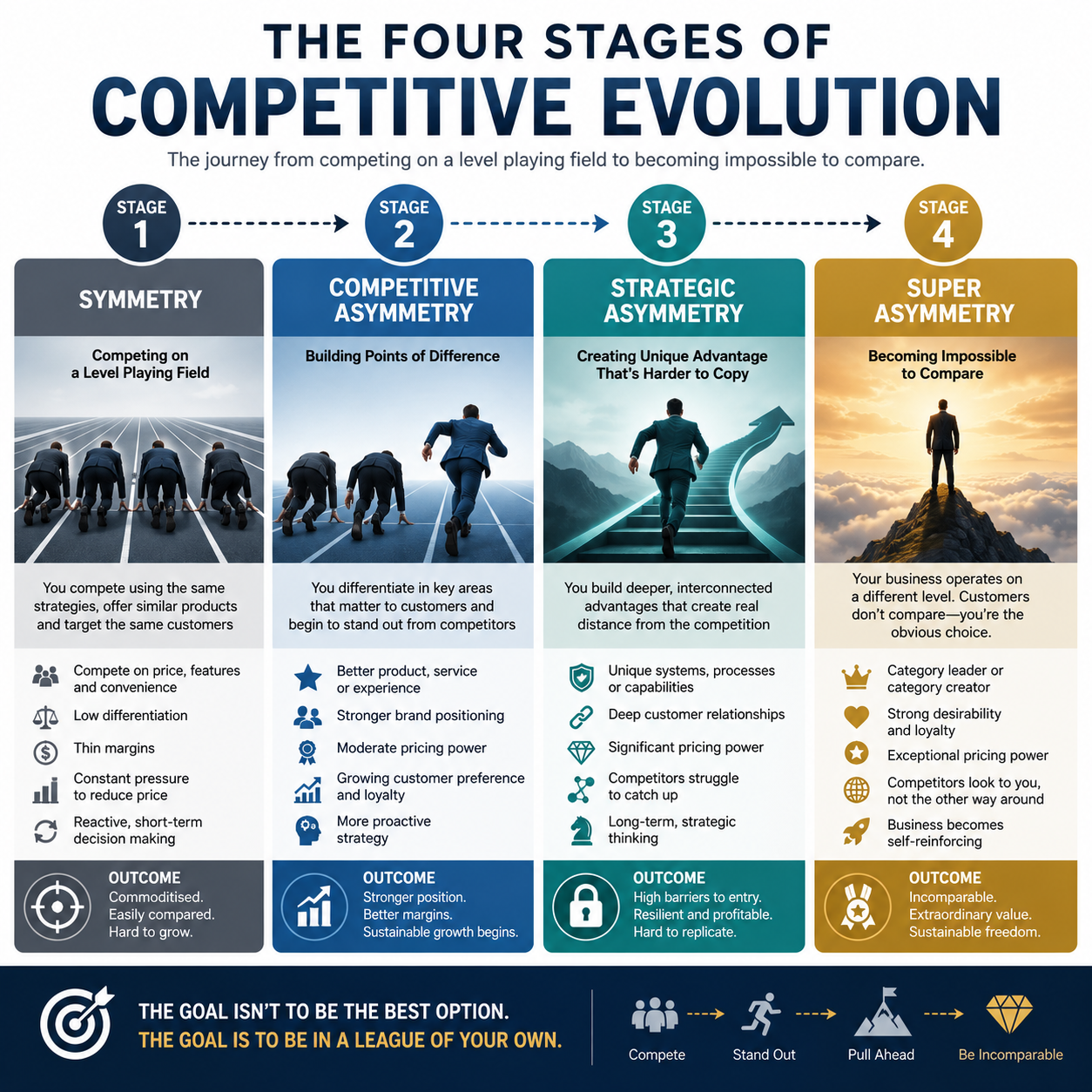
4. The Four Stages of Competitive Evolution.
If The Law of Super Asymmetry is correct, then one important conclusion follows. Businesses don’t suddenly become asymmetrical. Nor do they become symmetrical overnight. Instead, they move along a continuum.
Every strategic decision, whether it’s launching a new service, investing in technology, reducing prices, improving customer experience or adopting artificial intelligence, moves a business in one of two directions.
It either makes the business more symmetrical or more asymmetrical.
This is why I don’t see competitive advantage as something you either have or don’t have. I see it as a journey. Some businesses remain trapped in highly symmetrical markets for decades, constantly competing on price and struggling to protect their margins.
Others gradually develop advantages that competitors find increasingly difficult to copy. A small number go even further. They create such a powerful combination of reinforcing asymmetries that they stop being viewed as just another competitor altogether.
Understanding where your business sits on this continuum is one of the most valuable strategic exercises you can undertake.
To illustrate this, I believe every business passes through four distinct stages of competitive evolution. The first is where almost every business begins. Very few ever reach the fourth.
Stage 1 – Symmetry.
Every business begins its journey somewhere. Unfortunately, many never leave the first stage. I call this Symmetry.
This is the point where businesses become increasingly similar to one another. They sell comparable products, target similar customers, make similar promises and adopt similar business practices. They may genuinely believe they’re different, but from the customer’s perspective, the differences are often marginal.
Think about how many businesses describe themselves.
- “Quality products.”
- “Excellent customer service.”
- “Competitive prices.”
- “Professional advice.”
- “Family-run business.”
Browse ten websites within the same industry, and you’ll often find the same words, the same imagery and even the same promises repeated over and over again. That’s symmetry.
The businesses themselves may recognise subtle differences, but customers rarely do.
Instead, customers see a collection of suppliers that appear to offer much the same thing. Once that happens, buying behaviour changes.
Customers don’t ask, “Which business is the most unique?”
They ask, “Which one offers the best deal?”
Or,
“Can I get three quotes?”
That single request tells you almost everything you need to know. When customers actively seek multiple quotations, they are signalling that they perceive very little meaningful difference between the businesses they’re considering.
The businesses have become comparable.
Once comparison becomes easy, price inevitably becomes one of the dominant decision-making factors. This is why symmetrical industries almost always experience the same commercial pressures.
- Margins become thinner.
- Discounting becomes more common.
- Marketing costs increase.
- Customer loyalty declines.
- Winning new business requires ever greater effort.
- Businesses work harder simply to stand still.
Ironically, many businesses respond by becoming even more symmetrical. A competitor lowers prices. They lower theirs too. A competitor redesigns its website. They redesign theirs. Someone introduces AI. Everyone else rushes to implement AI. Someone launches a loyalty scheme. Soon everyone has one.
Every response narrows the gap instead of widening it. The entire industry gradually converges towards the same operating model. From the inside, every business still feels unique. From the outside, customers struggle to tell them apart. This is one of the greatest strategic traps in business. Companies become obsessed with matching competitors instead of escaping them.
They invest enormous time and money becoming slightly better versions of businesses that already exist, rather than becoming fundamentally different. I’ve seen this repeatedly when working with small and medium-sized businesses. Many owners can list every competitor within a twenty-mile radius.
- They know exactly what those competitors charge.
- They know what software they use.
- They know which staff have moved between firms.
- They know what services have recently been launched.
But when I ask them a much simpler question: “Why should a customer choose you if price wasn’t a factor?” the answer is often surprisingly vague. That’s because they’ve spent years benchmarking themselves against competitors instead of asking how they could become incomparable.
Symmetry isn’t the result of poor management. It’s the natural destination of businesses that continuously imitate one another.
Left unchecked, every industry drifts towards symmetry. And once an industry becomes highly symmetrical, it creates exactly the conditions that invite asymmetrical competitors to disrupt it. That’s why I don’t see symmetry as merely the first stage of competition. I see it as the starting point from which every business must consciously escape.
Stage 2 – Competitive Asymmetry.
The second stage is where many successful businesses begin to separate themselves from the crowd. They’ve recognised that simply being another supplier isn’t enough, so they invest in creating genuine points of difference.
- Perhaps they offer exceptional customer service.
- Perhaps they’ve built a stronger brand.
- Perhaps they specialise in a particular niche or have developed a reputation for quality.
Maybe they’ve embraced new technology before their competitors or introduced a more convenient way for customers to buy. These are all positive developments.
For the first time, the business begins to create asymmetry. Customers notice meaningful differences. The business gains new clients. Margins improve. Growth accelerates. At this stage, it often feels as though the company has discovered the secret to sustainable competitive advantage.
Unfortunately, this is also where many businesses make a critical mistake. They assume they’ve escaped competition. They haven’t. They’ve simply moved into the next phase of it. The problem is that most competitive advantages are visible.
- If your customer service is exceptional, competitors can improve theirs.
- If your website is better, competitors can redesign theirs.
- If you introduce online booking, fixed-fee pricing or AI-powered customer support, competitors can adopt the same technology.
- If your marketing campaign proves successful, others will soon begin using similar messages.
The market starts to copy you. Ironically, the more successful your innovation becomes, the more likely it is to be replicated. This is one of the great paradoxes of business.
Success attracts imitation.
Every innovation gradually becomes expectation. What once differentiated your business eventually becomes the minimum standard customers expect from everyone.
Think about contactless payments. When they were first introduced, they created a genuine competitive advantage for early adopters. Today, nobody chooses a retailer because they accept contactless payments.
Customers simply expect it.
The same has happened with online banking, free Wi-Fi, online tracking, customer portals and countless other innovations. Yesterday’s advantage becomes today’s hygiene factor. I’ve seen this repeatedly with professional service firms. One accountancy practice introduces fixed monthly fees. Within a few years, almost every practice offers them.
One law firm launches a client portal. Soon everyone has a client portal. One business embraces AI to automate routine tasks. It won’t be long before AI becomes an expected feature rather than a point of differentiation.
The business has certainly improved. But the market has improved with it. The competitive gap closes. The industry drifts back towards symmetry. That’s why I describe this stage as Competitive Asymmetry rather than Super Asymmetry.
The business has created advantages.
But those advantages remain largely tactical rather than strategic. They improve performance. They don’t fundamentally change the rules of competition. The business is still playing the same game as everyone else. It’s simply playing it a little better. Many businesses spend their entire lives in this stage.
They innovate. Competitors copy. They innovate again. Competitors catch up. The cycle repeats itself over and over.
It’s an exhausting way to build a business because every new advantage comes with an expiry date. This is where many leadership teams begin asking the wrong question.
“What’s the next thing we should do?”
I think the better question is:
“What could we build that becomes progressively harder to copy every year?”
That marks the transition to the third stage. Because real strategic advantage doesn’t come from having one great idea. It comes from creating a system of reinforcing advantages that competitors can’t easily replicate. That’s where Competitive Asymmetry begins to evolve into Strategic Asymmetry.
Stage 3 – Strategic Asymmetry.
The third stage is where business strategy becomes genuinely interesting. Most businesses spend their time trying to create individual competitive advantages.
- A better website.
- A stronger sales process.
- A new product.
- A more efficient operation.
- An AI tool.
- A marketing campaign.
All of these things can improve performance, but on their own they rarely create lasting strategic advantage.
Why?
Because individual advantages can usually be copied. Strategic asymmetry begins when your advantages stop existing in isolation and start reinforcing one another. The business starts to behave as an integrated system rather than a collection of separate activities. Everything becomes connected.
- A stronger brand attracts better customers.
- Better customers generate higher margins.
- Higher margins allow greater investment in people.
- Better people create exceptional customer experiences.
- Exceptional customer experiences generate stronger referrals.
- More referrals reduce the cost of acquiring new customers.
- The additional profit funds further innovation.
- Innovation strengthens the brand.
The cycle repeats itself. Notice what’s happened. No single advantage explains the success of the business. It’s the interaction between them that creates something competitors struggle to imitate. This is fundamentally different from Stage Two.
In Stage Two, competitors can usually identify the source of your advantage.
- “They’ve got a better website.”
- “Their prices are structured differently.”
- “They’ve invested in AI.”
- “Their marketing is excellent.”
The solution seems obvious. Copy it. Stage Three doesn’t work like that. Even if competitors can identify one of your strengths, copying it doesn’t produce the same outcome because they haven’t copied the entire system that supports it. Imagine trying to copy a Formula One team.
- You could recruit one of their engineers.
- You could buy similar equipment.
- You could even adopt similar technology.
But unless you recreate the leadership, the culture, the data, the processes, the decision-making, the funding and the hundreds of interactions between those elements, you’ll never achieve the same performance.
The system matters more than the individual components. Business works in exactly the same way. I’ve often found that business owners underestimate the value of these connections. They think about improving marketing.
- Or improving finance.
- Or improving operations.
- Or improving customer service.
Rarely do they ask how each improvement could strengthen everything else. That’s where Strategic Asymmetry begins. Instead of building isolated strengths, you deliberately create reinforcing advantages. Every improvement should make other improvements more valuable.
- Your finance function doesn’t simply produce accounts.
- It improves commercial decision-making.
- Better decisions improve pricing.
- Better pricing improves profitability.
- Greater profitability funds innovation.
- Innovation increases customer desirability.
Greater desirability strengthens pricing power. The system becomes self-reinforcing. The same applies to artificial intelligence. Many businesses are currently asking,
“How can AI save us time?”
That’s a perfectly reasonable question. But I think a far more strategic question is,
“How can AI strengthen every source of asymmetry in our business?”
- Can it deepen customer insight?
- Can it improve decision-making?
- Can it enhance the customer experience?
- Can it accelerate innovation?
- Can it strengthen relationships?
- Can it increase pricing power?
Used this way, AI stops being a productivity tool and becomes an asymmetry engine. This is the point where strategy changes fundamentally. The objective is no longer to build isolated competitive advantages. The objective is to build an interconnected business where every strength reinforces every other strength.
Once you’ve reached this stage, competitors face a completely different challenge. They’re no longer trying to copy a product, a service or a marketing campaign. They’re trying to copy an entire business system. That is significantly more difficult.
And it’s precisely why Strategic Asymmetry provides a far more sustainable source of competitive advantage than any single innovation ever could. It also provides the foundation for the fourth and final stage. Because when enough reinforcing asymmetries accumulate, something remarkable happens.
The business stops competing on the same terms altogether. It enters the realm of Super Asymmetry.
Stage 4 – Super Asymmetry.
The fourth and final stage is where a business fundamentally changes the nature of competition.
- It hasn’t eliminated competitors.
- It hasn’t become a monopoly.
- It hasn’t stopped customers having choices.
- Instead, it has achieved something far more valuable.
- It has become increasingly incomparable.
This is what I call Super Asymmetry.
At this stage, the business has accumulated so many reinforcing advantages that competitors find it extraordinarily difficult to compete on equal terms. The difference is no longer found in one product, one service or one marketing campaign. The difference is found in the entire business.
- Its reputation.
- Its people.
- Its systems.
- Its relationships.
- Its data.
- Its culture.
- Its customer experience.
- Its financial strength.
- Its ability to innovate.
Each element strengthens the next until the business becomes significantly greater than the sum of its individual parts.
The customer notices this too. Their questions begin to change. In Stage One they ask, “Who’s cheapest?” In Stage Two they ask, “Who’s better?” By Stage Three they begin asking, “Who understands our business best?” But in Stage Four the conversation becomes entirely different.
The question is no longer, “Which supplier should we choose?” It becomes, “How do we work with them?” That’s a subtle but incredibly important shift.
The business is no longer being evaluated alongside dozens of alternatives. It has become the preferred choice for a particular type of customer. Price doesn’t disappear. It simply becomes one factor among many rather than the defining factor.
This is why businesses operating in Stage Four often enjoy something every owner wants.
Pricing power.
Not because they’re the cheapest. Quite the opposite. Customers willingly pay more because they believe they’re receiving something they cannot obtain elsewhere.
People don’t buy Apple products because they’re the cheapest. They buy into an ecosystem.
People don’t choose the Ritz because it has the lowest room rates. They buy an experience.
People don’t hire the world’s leading barristers because they’re looking for value for money. They hire them because they believe the outcome justifies the investment.
The same principle applies to small businesses. A specialist engineering company may become the recognised expert in a particular manufacturing process. An accountant may become the authority on helping construction businesses improve profitability. A local restaurant may develop such a loyal following that tables are booked months in advance.
None of these businesses has eliminated competition. They’ve simply become far more difficult to compare. This is an important distinction.
Super Asymmetry isn’t about becoming famous. It isn’t about becoming the biggest business in your industry. It isn’t even about becoming the best.
It’s about becoming sufficiently distinctive that your ideal customers stop viewing you as interchangeable with everyone else. Ironically, businesses that achieve Super Asymmetry often appear to have very little competition.
People say, “Nobody does what they do.” In reality, that’s rarely true. Competitors still exist. They’re simply no longer viewed as direct substitutes. That’s the real objective.
The goal isn’t to eliminate competitors. The goal is to eliminate direct comparison.
This stage also creates something else that is often overlooked.
Resilience.
Businesses built on symmetry are constantly vulnerable to price pressure, economic downturns and new entrants. Businesses built on Super Asymmetry are far more resilient because their value extends far beyond the products or services they sell.
- Customers trust them.
- Employees want to work for them.
- Partners want to collaborate with them.
- Suppliers value the relationship.
They become stronger because of the ecosystem they’ve created rather than despite it.
Perhaps the greatest irony of all is this. Businesses that reach Stage Four often spend less time thinking about competitors than businesses trapped in Stage One. They aren’t ignoring the market. They’re simply no longer allowing competitors to define their strategy. Their focus shifts from reacting to others…to continually strengthening the asymmetries that made them successful in the first place.
And that’s the ultimate lesson of the Law of Super Asymmetry. The purpose of business is not to win the competition. It’s to build a business where meaningful competition becomes progressively less relevant.
Because when customers stop comparing you with everyone else, you’ve achieved something far more valuable than competitive advantage. You’ve achieved Strategic Irrelevance to Competition. That, ultimately, is the destination every business should aspire to reach.
5. The Eight Sources of Super Asymmetry.
By now you may be wondering what actually creates Super Asymmetry.
- Is it a great product?
- Exceptional customer service?
- A strong brand?
- Innovative technology?
The answer is both simpler and more complicated than that. None of these things, on their own, create Super Asymmetry. A great product can be copied. Excellent service can be matched. Technology eventually becomes available to everyone. Even strong brands can lose their position if they’re not continually reinforced.
Super Asymmetry doesn’t come from possessing one extraordinary strength.
It comes from combining multiple strengths that reinforce one another until the business becomes increasingly difficult to compare and even harder to replicate. Think of these as the building blocks of Super Asymmetry.
Every business will possess some of them.
The objective is to develop as many as possible and ensure they work together as a single strategic system.
5.1. Desirability Asymmetry.
This is, perhaps, the most important of them all. Customers don’t simply buy because your product is good. They buy because they want your product. The more desirable your business becomes, the less customers compare you with alternatives. Desirability reduces price sensitivity.
- It increases loyalty.
- It creates advocacy.
Most importantly, it shifts the customer’s mindset from, “Should I buy?” to, “How do I become a customer?”
This is one of the reasons I believe the Desirability Index is such a powerful measure of long-term business success.
5.2. Brand Asymmetry.
A brand is far more than a logo or colour scheme. It’s the collection of expectations people have before they ever speak to you. Strong brands reduce uncertainty. They create confidence. They simplify decision-making. Customers often assume branded businesses will provide a better experience before any evidence has been presented.
That is a remarkable competitive advantage.
5.3. Trust Asymmetry.
Buying almost always involves risk. Customers wonder whether they’ll receive value for money.
- Whether deadlines will be met.
- Whether promises will be kept.
Businesses that consistently reduce perceived risk create an enormous advantage.
- Testimonials.
- Case studies.
- Recommendations.
- Professional expertise.
- Transparent communication.
- All strengthen trust.
The easier you make it for customers to trust you, the less important price becomes.
5.4. Knowledge and Information Asymmetry.
Knowledge has always created competitive advantage. Today, data and artificial intelligence amplify it even further. Businesses that understand their customers more deeply make better decisions.
- They identify opportunities earlier.
- They solve problems faster.
- They personalise experiences more effectively.
The competitive advantage isn’t simply possessing information. It’s using it better than anyone else.
5.5. Capability Asymmetry.
Some businesses simply become exceptionally good at what they do. Not because they work harder. But because they’ve developed capabilities competitors struggle to reproduce.
- Their people.
- Their culture.
- Their processes.
- Their intellectual property.
- Their accumulated experience.
Capabilities compound over time. The longer they’re developed, the harder they become to copy.
5.6. Financial Asymmetry.
Financial strength is often overlooked as a source of competitive advantage. It shouldn’t be. Healthy cash flow gives businesses options. It allows investment during downturns.
- It funds innovation.
- It attracts better people.
- It creates resilience.
Businesses with strong finances don’t simply survive uncertainty. They frequently use uncertainty to increase the gap between themselves and weaker competitors.
5.7. Relationship Asymmetry
Some businesses don’t merely acquire customers. They build communities. Relationships create loyalty that competitors struggle to break.
- Long-standing customers.
- Strategic partnerships.
- Referral networks.
- Industry influence.
These create switching costs that go far beyond contractual agreements. People rarely leave businesses they genuinely trust.
5.8. Innovation Asymmetry.
Innovation isn’t about inventing something revolutionary every year. It’s about continuously moving the business forward.
- Small improvements.
- Better systems.
- New ideas.
- Smarter processes.
- Earlier adoption of valuable technologies.
Innovation keeps creating fresh asymmetries before existing ones become symmetrical. Perhaps that’s its greatest value. It ensures your business never stands still long enough for competitors to catch up.
The Power Isn’t in the Individual Asymmetries
Notice something about these eight sources. None of them exists in isolation. A stronger brand increases trust. Greater trust improves pricing power. Higher margins generate stronger cash flow. Healthy cash flow funds innovation. Innovation strengthens capability. Better capability improves customer experience. Customer experience increases desirability. Desirability reinforces the brand.
The cycle begins again. This is why I believe businesses should stop asking, “What’s our competitive advantage?” It’s the wrong question. The better question is,
“How many reinforcing asymmetries are we creating?”
Because Super Asymmetry isn’t one advantage. It’s an ecosystem of advantages working together. And the businesses that build the strongest ecosystems become the businesses that competitors find almost impossible to imitate.
6. Why Most Businesses Never Escape Symmetry.
If Super Asymmetry creates stronger businesses, a natural question follows. Why don’t more businesses achieve it? After all, every business owner wants higher margins, stronger customer loyalty and less price competition.
So why do so many remain trapped in symmetrical markets?
I don’t believe it’s because business owners lack ambition. Nor do I believe it’s because they lack intelligence. I think the real reason is far simpler.
Symmetry feels safe.
From the moment we start a business, we’re encouraged to study our competitors. We’re told to benchmark against industry leaders.
- To follow best practice.
- To learn from successful businesses.
- To adopt proven systems.
None of this is bad advice. In fact, it’s excellent advice if your objective is operational efficiency. The problem arises when operational thinking replaces strategic thinking. Every time we copy what works elsewhere, we become a little more like everyone else.
- A competitor introduces online booking.
- We introduce online booking.
- They launch fixed-fee pricing.
- We launch fixed-fee pricing.
- They invest in artificial intelligence.
- We invest in artificial intelligence.
- They redesign their website.
- We redesign ours.
Individually, these are sensible decisions. Collectively, they drive the entire industry towards greater symmetry. The irony is that businesses often congratulate themselves for “keeping up.” Strategically, keeping up rarely creates leadership.
It creates similarity. I’ve lost count of the number of meetings where someone has said,
“Our competitors are doing this, so we probably should too.”
It’s an understandable reaction. But it’s also one of the fastest routes to becoming indistinguishable. Competitors should certainly be observed. They should not become your blueprint. Because once your strategy becomes reactive, your future is being shaped by someone else’s decisions.
- That’s not leadership.
- That’s imitation.
The danger is compounded by what psychologists call social proof. When everyone in an industry behaves in the same way, that behaviour starts to feel unquestionably correct. If every accountancy firm charges by monthly subscription, surely that’s the right model. If every restaurant offers online ordering, surely we should too. If every engineering company claims exceptional customer service, we’d better make the same claim.
Over time, the entire industry begins reinforcing the same behaviours.
Nobody questions them because everyone is doing them. This creates an illusion of safety. But history repeatedly shows that industries become most vulnerable precisely when everyone starts thinking alike.
The British motor industry provides a powerful example.
For years, manufacturers focused on competing with one another. They benchmarked domestic rivals, refined existing products and fought for market share within a familiar competitive landscape.
Meanwhile, manufacturers from Japan were building entirely different capabilities around quality, reliability, manufacturing efficiency and continuous improvement.
By the time British manufacturers recognised the scale of the challenge, they weren’t facing slightly better competitors. They were facing businesses built on fundamentally different principles. The same pattern has repeated itself throughout history.
- Kodak believed it competed with other film manufacturers.
- Blockbuster believed it competed with other video rental stores.
- Traditional taxi firms believed they competed with other taxi firms.
- Hotels believed they competed with other hotels.
Each industry became increasingly symmetrical. Each became vulnerable to businesses that redefined the basis of competition. That’s why I believe one of the greatest dangers in strategy is confusing best practice with competitive advantage.
Best practice improves efficiency. Eventually, everyone adopts it. Competitive advantage disappears. Strategic advantage comes from creating practices that are valuable, distinctive and difficult to imitate.
Another reason businesses remain trapped in symmetry is that genuine asymmetry often feels uncomfortable. It requires making choices that competitors aren’t making. It requires saying no to opportunities that don’t reinforce your strategy. It may involve charging significantly more than the market. Serving fewer customers. Specialising more deeply. Investing in capabilities whose benefits won’t become obvious for years.
These decisions feel risky because they move you away from the accepted norms of your industry. Yet that’s exactly where asymmetry is created. The safest decision in the short term is often the most dangerous decision in the long term.
Every time you follow the crowd, you reduce the distance between your business and everyone else’s. Every time you create a meaningful difference that competitors cannot easily replicate, you increase that distance. Ultimately, this is why so few businesses escape symmetry. They’re trying to become the best version of what already exists.
The businesses that achieve Super Asymmetry pursue a very different objective. They aren’t asking,
“How can we do this better?”
They’re asking,
“How can we do this so differently that meaningful comparison becomes increasingly difficult?”
That single question changes the direction of the business. It moves strategy away from imitation and towards innovation. Away from benchmarking and towards originality. Away from competing harder…and towards becoming increasingly incomparable.
7. AI Changes Everything
No discussion about Super Asymmetry would be complete without talking about artificial intelligence. AI is undoubtedly one of the most transformative technologies we’ll see in our lifetime. It has the potential to change how we market, sell, recruit, analyse data, communicate with customers and make decisions. Almost every business function will be influenced in some way. Yet I believe many businesses are asking the wrong question.
The question I hear most often is: “How can AI make us more efficient?” It’s a sensible question. But it’s also a dangerously limited one. Efficiency has never been a sustainable source of competitive advantage. Eventually, everyone becomes more efficient.
The businesses that ask only how AI can save time or reduce costs are focusing on operational improvement. They’re not thinking strategically. History suggests this is exactly what will happen. Within a few years, every business will have access to remarkably similar AI tools.
- Every business will be able to generate marketing content.
- Every business will automate customer enquiries.
- Every business will analyse financial data.
- Every business will build sales forecasts.
- Every business will create proposals in minutes rather than hours.
- Every business will use AI to improve productivity.
When that happens, AI itself stops being a competitive advantage. It becomes another utility. Much like email. Or cloud accounting. Or video conferencing.
Nobody wins business today because they use Microsoft Excel. Nobody gains a competitive advantage simply because they have a website. Nobody differentiates themselves because they use cloud accounting software. Those technologies were once revolutionary. Today they’re expected.
I believe AI will follow exactly the same path.
Businesses that rely on AI alone to differentiate themselves will eventually discover they’ve become just as symmetrical as everyone else. This is where the Law of Super Asymmetry becomes particularly relevant. The real question isn’t,
“How can AI improve our business?” It’s, “How can AI increase our asymmetry?” That’s a fundamentally different conversation.
- Can AI help us understand our customers better than anyone else?
- Can it identify opportunities competitors fail to see?
- Can it personalise every customer interaction?
- Can it improve pricing decisions?
- Can it strengthen our advisory capability?
- Can it accelerate innovation?
- Can it make better decisions, not simply faster ones?
These questions move AI from the back office into the boardroom. They transform AI from an efficiency tool into a strategic capability.
Take professional services as an example.
Most firms are already using AI to draft emails, write reports and summarise meetings. Those are useful applications. But they don’t fundamentally change the competitive landscape because every other firm can do exactly the same thing.
Imagine instead an accountancy practice that combines decades of financial expertise with proprietary data, industry benchmarking, predictive analytics and AI-powered commercial insight. The client isn’t paying for AI. They’re paying for decisions that competitors simply cannot provide.
That’s asymmetry.
The same applies to manufacturing. One factory might use AI to reduce machine downtime. Another might use the same technology to redesign its entire production model, predict customer demand, optimise inventory and shorten product development cycles.
Both are using AI. Only one is creating strategic asymmetry.
This is why I believe the biggest winners in the AI era won’t necessarily be the businesses with the most advanced technology. They’ll be the businesses that integrate AI most effectively into their existing asymmetries.
- A trusted brand becomes even stronger because AI improves customer experience.
- A knowledgeable advisory firm becomes even more valuable because AI expands its insight.
- A financially disciplined business allocates capital more effectively because AI improves forecasting.
AI amplifies existing strengths. It rarely replaces them. In fact, there’s an important paradox here.
As AI becomes universally available, it will make many businesses more alike. The barriers to producing good marketing, analysing data, writing proposals and automating administration will fall dramatically. In other words, AI will increase symmetry across many industries.
Ironically, this means the value of genuine asymmetry will become even greater. When everyone can produce competent work, customers begin looking for exceptional judgement. When everyone can automate routine tasks, relationships become more valuable. When everyone has access to the same technology, the businesses that combine technology with trust, expertise, brand and customer understanding will create the greatest value. Technology may become symmetrical.
- Judgement will not.
- Trust will not.
- Reputation will not.
- Relationships will not.
- Strategic thinking will not.
Those remain profoundly human advantages. This is why I don’t believe AI threatens the Law of Super Asymmetry. I believe it reinforces it. AI will undoubtedly change the rules of competition. But it won’t eliminate competition.
It will simply raise the standard expected of every business. The businesses that thrive won’t be those asking,
“How can AI make us more efficient?”
They’ll be asking a far more important question. “How can AI help us build a business that competitors find increasingly impossible to imitate?”
Because in the age of artificial intelligence, efficiency will become commonplace. Super Asymmetry will become priceless.
8. The Desirability Index Revisited
As I was developing the concept of the Law of Super Asymmetry, I realised something interesting. The Desirability Index wasn’t simply a pricing model.
- It wasn’t just a sales framework.
- It wasn’t even just a way of understanding customer behaviour.
- It was measuring something much bigger.
It was measuring one of the most powerful forms of business asymmetry. For years I’ve argued that businesses don’t compete primarily on price. They compete on desirability. The businesses customers most want to buy from almost always enjoy stronger margins, greater customer loyalty and higher long-term profitability than those that merely compete on price.
At the time, I viewed desirability as a commercial advantage. Today, I think it’s something far more significant.
I believe desirability is one of the foundations of Super Asymmetry. Think about your own buying behaviour. When you genuinely want something, your behaviour changes. You stop looking for reasons not to buy. Instead, you start looking for reasons to justify buying.
- Price becomes less important.
- Waiting becomes acceptable.
- Travelling further feels worthwhile.
You become remarkably tolerant of inconvenience because you believe the outcome justifies the effort. We’ve all experienced it. People happily queue for the latest iPhone. They wait months for a reservation at a Michelin-starred restaurant. They travel across the country to work with a specialist consultant.
None of these customers is behaving irrationally. They’re responding to desirability.
The business has created something customers genuinely want rather than something customers simply need. That’s an incredibly powerful position to occupy because desirability changes the basis of competition.
Customers stop asking, “Which option is cheapest?” They begin asking, “How do I get that?”
That’s a completely different buying psychology. The comparison has shifted. Or, in many cases, disappeared altogether. This is why I believe the Desirability Index deserves to be viewed through a different lens.
It’s not simply measuring how attractive a business is. It’s measuring how difficult that business has become to compare. The more desirable a business becomes, the greater its asymmetry. The greater its asymmetry, the less vulnerable it becomes to price competition.
This explains why two businesses selling almost identical products can achieve dramatically different financial results.
One constantly discounts. The other rarely needs to. One chases customers. The other attracts them. One spends heavily on marketing simply to replace customers who leave. The other enjoys referrals, repeat business and growing demand.
The products may not be dramatically different. The desirability certainly is.
This also explains why I believe many businesses focus on the wrong metrics. They measure market share. Revenue. Profit. Website traffic. Social media followers. All of these are useful. But they’re outcomes.
I would argue that one of the most important strategic questions any leadership team should ask is much simpler. “How desirable are we becoming?”
Because desirability influences almost everything else, higher desirability creates greater trust. Greater trust strengthens pricing power. Higher prices improve profitability. Greater profitability funds innovation. Innovation improves customer experience. Customer experience strengthens reputation. Reputation increases desirability.
The cycle reinforces itself. Notice how closely this mirrors the principles of Super Asymmetry. Neither is built around one extraordinary strength. Both are systems of reinforcing advantages. In fact, I now believe the Desirability Index should be viewed as one of the core measures within the Law of Super Asymmetry.
If Super Asymmetry describes the destination, then the Desirability Index measures one of the most important routes for getting there. It answers a question that many businesses never stop to consider.
Not,
“How satisfied are our customers?”
Not,
“Would customers recommend us?”
But something much more revealing.
“If our customers had to choose again tomorrow, how strongly would they want to choose us?”
That is a very different question.
Satisfaction can be achieved by meeting expectations. Desirability is created by exceeding them in ways competitors struggle to replicate. Ultimately, I believe every business should aspire to become the obvious choice for the customers it wants to serve.
- Not because it’s the cheapest.
- Not because it’s the most convenient.
But because it has become the most desirable. When that happens, something remarkable occurs. Customers stop comparing. Competitors stop dictating your strategy. Price stops dominating the conversation. And your business takes another significant step towards Super Asymmetry. Perhaps that’s the simplest way to think about the relationship between the two ideas.
The Desirability Index measures how much customers want your business. The Law of Super Asymmetry explains what happens when enough customers do.
9. Conduct Your Own Super Asymmetry Audit
By now, you may have started recognising where your own business sits on the journey from symmetry to Super Asymmetry. Perhaps you’ve identified areas where you’ve become too similar to your competitors. Perhaps you’ve recognised strengths that competitors struggle to replicate. Or perhaps you’ve realised that your strategy has become more reactive than proactive.
Whatever your conclusions, one thing should now be clear.
Every business sits somewhere on the Super Asymmetry continuum.
The important question isn’t whether you’re symmetrical or asymmetrical. The important question is: “Which direction are we moving?”
Every strategic decision either increases the distance between your business and the competition…or reduces it.
That’s why I believe every leadership team should periodically conduct a Super Asymmetry Audit. Not as a marketing exercise. Not as a financial review. But as a strategic discussion about the future of the business. Below are some of the questions I would ask.
Market Position
- Why do customers choose us instead of our competitors?
- Are those reasons genuinely unique, or could our competitors make exactly the same claims?
- If we disappeared tomorrow, what would customers miss most?
- What makes us difficult to compare?
Customer Value
- Are customers buying our product…
or buying what our product enables them to achieve? - How much of our pricing power comes from genuine value rather than competitive pricing?
- Are customers attracted to us…
or simply settling for us?
Competition
- Which competitors do we monitor most closely?
- Are we spending too much time reacting to them?
- Could the greatest threat to our business come from outside our industry?
- If a completely new competitor entered the market tomorrow, what asymmetries would they exploit?
Capability
- What can we genuinely do better than anyone else?
- Which capabilities would take competitors years—not months—to replicate?
- Are our strengths individual…
or do they reinforce one another?
Financial Strength
- Does our financial position give us strategic options that weaker competitors don’t have?
- Could we continue investing during an economic downturn?
- Are we using profit to strengthen future asymmetry or simply maintaining the status quo?
Innovation
- When was the last time we changed the rules rather than simply improved the game?
- Are we creating new asymmetries faster than competitors can copy existing ones?
- Are we investing in innovation…
or merely responding to it?
Artificial Intelligence
- Are we using AI simply to improve efficiency?
- Or are we using AI to create capabilities competitors cannot easily match?
- Is AI making us different…
or simply helping us keep up?
Leadership
Perhaps the most important questions of all are directed at the leadership team.
- Are our strategic decisions moving us towards greater symmetry or greater asymmetry?
- Are we building a business that customers actively seek out…
or one that customers simply compare? - If we were starting this business again today, would we build it in exactly the same way?
Those questions aren’t always comfortable. In fact, they shouldn’t be.
The purpose of a Super Asymmetry Audit isn’t to confirm that everything is working well. Its purpose is to expose the assumptions that may be quietly pulling your business back towards symmetry.
The One Question That Matters Most
If I had to reduce the entire audit to a single question, it would be this:
“If our three biggest competitors copied everything we do over the next twelve months, what would still make us different?”
Take a moment to think about your answer. If your response is,
“Not very much,”
then your competitive advantage is probably tactical rather than strategic. If, however, your answer includes your reputation, your relationships, your knowledge, your systems, your culture, your data, your brand and the way all of those things reinforce one another…then you’re well on your way to building Super Asymmetry.
Because that’s the real objective. Not creating one advantage. Creating a business that becomes increasingly impossible to replicate. And that’s the journey every great business eventually undertakes.
Final Word – Stop Trying to Win Fairly
When I began writing this article, I made a statement that may have seemed controversial. I said I don’t believe businesses should aspire to compete on a level playing field. By now, I hope that statement makes a little more sense.
For generations we’ve been taught that business is about competition. We’re encouraged to analyse competitors. Benchmark best practice. Improve our products. Lower our costs. Increase our marketing. Win market share.
There’s nothing inherently wrong with any of those activities. But they’re all based on one underlying assumption. That the objective is to become better at playing the existing game.
I no longer believe that’s the objective.
I believe the objective is to create a business that plays a different game altogether. History repeatedly demonstrates that the businesses creating the greatest value rarely become successful by doing the same things slightly better than everyone else.
- They succeed because they redefine what customers value.
- They change expectations.
- They alter buying behaviour.
- They make old comparisons less relevant.
In other words, they create asymmetry. The more I study successful businesses, the more convinced I become that this isn’t an exception.
It’s the pattern.
Businesses that become increasingly symmetrical find themselves trapped in endless competition. Businesses that deliberately create asymmetry steadily escape it. That’s why I believe every strategic decision should be judged against one simple question:
“Does this make us more symmetrical or more asymmetrical?”
It doesn’t matter whether you’re investing in artificial intelligence. Recruiting a new employee. Launching a product. Changing your pricing. Redesigning your website. Entering a new market.
Or acquiring another business.
Every decision either reduces the distance between you and your competitors…or increases it.
That is the true test of strategy. Not whether something is fashionable. Not whether competitors are doing it. Not whether it’s considered best practice. But whether it strengthens the asymmetries that make your business increasingly valuable and increasingly difficult to imitate.
Because here’s the uncomfortable truth.
If your competitors can easily copy your strategy…it probably isn’t a strategy. It’s an operational improvement. True strategy creates distance. And distance creates freedom.
- Freedom from constant price competition.
- Freedom from reacting to every competitor.
- Freedom to invest.
- Freedom to innovate.
- Freedom to choose the customers you want to work with.
Ultimately, that’s what every business owner is really trying to achieve. Not simply a more profitable business.
A more resilient business. One that’s less vulnerable to economic cycles, changing technologies and aggressive competitors. One that customers actively seek out rather than merely compare. One that employees are proud to work for. One that competitors respect but struggle to imitate.
That’s the destination I believe every business should pursue. Not perfection. Not monopoly. Not domination. Super Asymmetry.
Because I don’t believe the future belongs to the businesses that compete the hardest. I believe it belongs to the businesses that become the hardest to compete against. So stop trying to win fairly. Stop trying to become a slightly better version of everyone else. Stop allowing competitors to define your strategy.
Instead, focus on building a business that customers genuinely desire, competitors genuinely admire, and the market finds increasingly difficult to compare.
Because the greatest competitive advantage isn’t winning on a level playing field. It’s making the level playing field irrelevant.
That, ultimately, is “The Law of Super Asymmetry.”
Pricing Strength Audit™ – Discover Your Level of Business Symmetry
If there’s one question I’d like you to take away from this article, it’s this:
How easy is it for your customers to compare your business with your competitors?
If the answer is very easy, then there’s a good chance your business has become highly symmetrical. That doesn’t necessarily mean you’re running a poor business. It simply means you’re competing on terms your competitors understand just as well as you do.
And that’s where price pressure, shrinking margins and constant competition begin. The good news is that symmetry isn’t permanent. It can be measured. It can be challenged.
And, with the right strategy, it can be transformed into genuine competitive strength. That’s exactly why I’ve developed the Pricing Strength Audit™.
Despite the name, this isn’t simply a review of your pricing. In fact, pricing is often just the symptom. The real question is why your business has the pricing power it has today.
Together we’ll examine the factors that determine whether customers see your business as just another option, or as the obvious choice.
We’ll assess the sources of symmetry within your business and identify where opportunities exist to build meaningful asymmetry.
The audit explores questions such as:
- How easy is your business to compare with competitors?
- Where are you creating genuine customer desirability?
- How much pricing power do you actually possess?
- Which aspects of your business are easiest for competitors to copy?
- Which asymmetries are already working in your favour?
- Where are the greatest opportunities to strengthen your market position?
- Are you building a business that competes on price, or one that commands a premium?
By the end of the process, you’ll have a clear picture of where your business currently sits on the Super Asymmetry Continuum, together with practical recommendations for increasing your pricing strength and reducing your dependence on price-based competition.
Because my goal isn’t simply to help you increase your prices. It’s to help you build a business where customers understand why you’re worth paying more. That’s a very different objective.
One leads to higher prices. The other leads to a stronger business.
And in my experience, stronger businesses almost always earn higher prices naturally.
If you’re ready to discover whether your business is trapped in symmetry, or already building Super Asymmetry, I’d love to help.
Book your Pricing Strength Audit™ and take the first step towards building a business that’s increasingly difficult to compare, increasingly difficult to copy and increasingly valuable to your customers.