
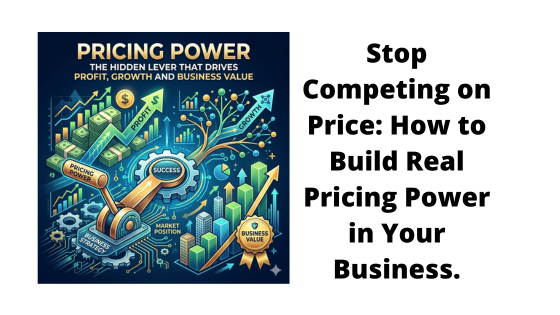
Pricing Power – The Most Misunderstood Lever in Business.
Listen to the audio version of this blog post.
Watch a video summary of this post.
If you sit down with most business owners and ask them what drives their success, you’ll hear the same answers again and again:
- “We need more leads.”
- “We need to cut costs.”
- “We need to increase sales.”
And on the surface, that all sounds sensible. But in my experience of working with hundreds of businesses, these are not the real levers that determine whether a business thrives or struggles. The real lever is pricing power. The problem is, almost no one talks about it properly.
Most businesses I come across are stuck in a cycle they don’t even realise they’re in.
- They chase more volume to compensate for low margins.
- They discount to win work.
- They compare themselves to competitors and try to be “competitive” on price.
What they’re actually doing is giving up control of their business, one decision at a time.
I saw this recently with a contractor doing around £2m in revenue. Busy, growing, plenty of work in the pipeline. On paper, it looked like a solid business. But when we dug into it, every job was priced to “win the work,” not to maximise value. Margins were thin. Any variation or delay wipes out profit. Cash flow was constantly under pressure.
- They didn’t have a sales problem.
- They didn’t have a cost problem.
They had a pricing power problem.
Compare that to another business I worked with in a similar sector, smaller, less volume, fewer clients. But they had positioned themselves as specialists. They were known for a specific type of work. Their proposals were structured differently. Their messaging was clear. And crucially, they weren’t trying to be the cheapest. They were charging 20–30% more than their competitors.
And still winning the work. Why? Because they had built pricing power.
This is the shift most business owners never make. They think pricing is about numbers:
- Mark-up
- Margin
- Cost plus
It’s not. Pricing power is about control.
- It’s the ability to set your price based on value, not fear.
- It’s the ability to increase prices without losing customers.
- It’s the difference between being chosen… and being compared.
And here’s the bigger point: this doesn’t just affect your pricing. Pricing power impacts everything:
- Your profitability
- Your cash flow
- Your confidence in sales conversations
- Your ability to invest in growth
- And ultimately… the value of your business
Two businesses can generate the same profit. But the one with pricing power will always be more valuable.
- More predictable.
- More resilient.
- More attractive to a buyer.
I want to strip this back and show you what’s really going on. We’re going to look at:
- What pricing power actually is (and what it isn’t)
- How brand and positioning drive it
- Why does it have such a dramatic impact on profit and valuation
- And most importantly, how to start building it in your business
Because once you understand this, everything changes. You stop chasing work. And start becoming worth more.
2. What Is Pricing Power? (And Why It Matters).
Refining the Definition of Pricing Power.
Most people define pricing power too narrowly. They say:
“Pricing power is the ability to increase your prices without losing customers.”
That’s true, but it’s incomplete. Because pricing power isn’t just about putting prices up. It’s about control over your pricing, regardless of what the market is doing.
A Better Definition.
A more accurate definition is this:
“Pricing power is the ability to set, maintain, and justify your prices, regardless of competitive pressure.”
That includes three things:
- The ability to raise prices
- The ability to hold your price when others discount
- The ability to charge more in the first place
Most businesses fail on all three.
Holding Your Price in a Competitive Market.
This is where pricing power really shows up. Any business can drop its price. Very few can hold it when:
- Competitors undercut them
- Customers push for discounts
- The market becomes more aggressive
This is where weak businesses fold. They panic. They reduce the price. They tell themselves, “We need to stay competitive.” What they’re actually doing is eroding their margins and training the market to expect lower prices.
Businesses with pricing power do the opposite. They hold the line. Not because they’re stubborn, but because they’ve built a position where price is no longer the primary decision factor.
Charging More From the Start.
This is the part most people miss entirely. Pricing power isn’t just reactive, it’s proactive. It’s the ability to enter the market already priced higher and still win.
Take brands like McVitie’s or Heinz.
Walk into any supermarket, and you’ll see it immediately.
- Their products sit next to cheaper alternatives
- Often significantly cheaper alternatives
- Yet they consistently command a premium
In some cases, double the price. Now logically, that shouldn’t work. If pricing were purely rational, everyone would buy the cheaper option. But they don’t. Because these brands have built pricing power over time through:
- Trust
- Consistency
- Recognition
- Perceived quality
Customers aren’t just buying the product. They’re buying certainty.
The Real Insight.
This is the shift that changes everything:
“Pricing power is not about what you charge. It’s about what the customer is willing to accept.”
And that acceptance is not driven by your costs. It’s driven by:
- Perception
- Positioning
- Confidence
- Risk reduction
Why This Matters.
Once you understand this, you stop asking:
- “What should we charge?”
- “What are competitors charging?”
And start asking:
- “Why would a customer willingly pay more for us?”
- “What allows us to hold our price under pressure?”
- “What makes us incomparable?”
Because that’s where pricing power actually lives.
Bringing It Back to Your Business.
If your pricing is constantly under pressure…If customers are negotiating before they’ve even understood your value…If competitors can easily undercut you…Then the issue isn’t your pricing. It’s your pricing power. And until that changes, no pricing strategy will fix it.
Price Taker vs Price Maker.
In reality, every business sits somewhere on a spectrum. At one end, you have price takers. These are businesses where:
- The market dictates the price
- Customers compare purely on cost
- Margins are squeezed
- Winning work often means being cheaper than the next guy
You see this all the time in commoditised sectors. Take a general contractor quoting for standard work. Three quotes go in. The client lines them up side by side. And what happens? The decision is heavily influenced by price. That business isn’t really setting its price; it’s reacting to the market.
At the other end, you have price makers.
These businesses:
- Set their own pricing structure
- Are chosen for specific reasons beyond cost
- Experience far less price resistance
- Often don’t even compete in the same way
Think about a specialist firm that focuses on a very specific type of high-value work. They’re not one of three quotes. They’re the choice. Their pricing isn’t compared; it’s accepted.
A Practical Example.
I’ve seen this play out repeatedly. Two businesses. Same sector. Similar capability.
Business A:
- “We need to stay competitive”
- Prices based on what others are charging
- Constant negotiation
- Margins under pressure
Business B:
- Clear positioning
- Defined niche
- Strong reputation in that niche
- Pricing based on value delivered
Business B often charges significantly more, sometimes 20–30% more, and still wins the work. Not because they’re “better” technically. But because they have pricing power.
Why This Matters More Than Anything Else.
Here’s the key point most people miss:
Pricing power is the difference between surviving and scaling.
If you don’t have pricing power:
- Growth creates stress, not profit
- More work means more risk
- Cash flow becomes unpredictable
- Every job needs to go right just to make money
You’re effectively running harder just to stand still.
But when you have pricing power:
- Margins increase without increasing workload
- Profit improves faster than revenue
- You can absorb risk and variability
- You gain confidence in sales conversations
- You attract better clients
And most importantly…You start to take control of your business instead of reacting to it.
The Brutal Truth.
Most businesses believe they have pricing power. They don’t.
They think:
- “Our service is better”
- “Our customers value us”
- “We’re not the cheapest”
But the real test is simple:
Can you raise your prices consistently, without losing work? If the answer is no, then you’re still operating as a price taker… whether you realise it or not.
And that’s why this matters.
Because until you build pricing power, every other improvement: marketing, sales, operations, will always be working against a ceiling. Remove that ceiling… and everything changes.
3. The Spectrum of Pricing Power.
Not all businesses are equal when it comes to pricing. In fact, most sit on a spectrum, whether they realise it or not. Understanding where you are on this spectrum is critical because it determines:
- Your margins
- Your sales conversations
- Your growth potential
- And ultimately… your business value
Here’s the reality.
3.1. Price Taker – The Market Is in Control.
You don’t set the price. The market does.
- Competing on the cheapest
- Constant price comparison
- Margins are thin and fragile
- Winning work = being lower than the next quote
Typical businesses:
- General trades
- Undifferentiated service providers
- Commodity products
At this level, you’re not really running a pricing strategy. You’re reacting.
3.2. Competitive Pricer – Following the Market.
You have some control, but not much.
- Pricing is based on competitors
- You aim to be “in line” or slightly better
- Occasional premiums, but easily challenged
- Discounts still play a role
Typical businesses:
- Established SMEs
- Businesses with decent service but unclear positioning
This is where most businesses sit. They’re not the cheapest… But they’re not truly different either.
3.3. Differentiated Player – Justifying a Premium.
Now things start to change.
- Clear positioning or niche
- Value is understood before price is discussed
- Able to charge more and defend it
- Less reliance on discounting
Typical businesses:
- Specialists
- Niche providers
- Businesses with a strong reputation or expertise
At this level, pricing becomes a strategic tool, not a defensive one. You’re no longer being compared in the same way.
3.4. Price Maker – Setting the Market.
This is where real pricing power exists.
- You set the price, others follow
- Little to no price resistance
- Customers choose you before seeing alternatives
- Price becomes secondary to trust, brand, or outcome
Typical businesses:
- Category leaders
- Premium brands
- Highly specialised experts
Think again of brands like Heinz or McVitie’s. They don’t compete on price. They define it.
The Reality Most Businesses Don’t Want to Admit.
Here’s the uncomfortable truth:
Most SMEs believe they are differentiated… but are actually operating as competitive pricers.
They tell themselves:
- “We offer better service”
- “We care more about our customers”
- “We’re not the cheapest”
But when pressure hits…
- They discount.
- They negotiate.
- They justify their price.
Which means they’re still being compared.
Why This Matters.
Your position on this spectrum determines everything.
- Price Taker → Survival mode
- Competitive Pricer → Stable, but limited
- Differentiated Player → Profitable growth
- Price Maker → Scalable, valuable, defensible business
The goal isn’t just to increase prices. It’s to move up the spectrum. Because the higher you move…The lower price matters. And the more control you gain.
4. The Link Between Brand and Pricing Power.
Most business owners misunderstand what a brand actually is. They think it’s:
- A logo
- A colour scheme
- A website
It’s not. Your brand is your pricing leverage. It’s the reason a customer chooses you before they compare you. And that changes everything.
Trust Reduces Price Sensitivity.
When a customer trusts you, price becomes less important. Not irrelevant, but less decisive. Think about your own behaviour. When you trust a provider:
- You don’t shop around as much
- You don’t question every line item
- You don’t immediately push back on price
Why?
Because trust removes risk. And when risk goes down… willingness to pay goes up.
Perceived Value Always Beats Actual Cost.
Here’s the key principle:
“Customers don’t buy based on cost. They buy based on perceived value.”
Two products can cost exactly the same to produce…But be sold at completely different prices. Take Heinz beans versus a supermarket’s own brand.
- Similar ingredients
- Similar production processes
- Often made in comparable facilities
Yet one consistently commands a premium. Why? Because the perception of value is higher.
The same applies to McVitie’s. You’re not paying for biscuits. You’re paying for:
- Familiarity
- Consistency
- Trust
- Expectation of quality
That is brand in action.
Premium vs Generic – The Real Difference.
Generic providers compete on:
- Price
- Availability
- Convenience
Premium providers compete on:
- Confidence
- Outcome
- Experience
And that’s the shift. A premium business isn’t just selling a service. It’s selling certainty.
The Four Drivers of Brand-Led Pricing Power.
If you strip it back, strong pricing power driven by brand comes from four core areas:
4.1. Reputation
What people say about you when you’re not in the room.
- Proven results
- Testimonials
- Track record
Reputation reduces perceived risk instantly.
4.2. Consistency
Can customers rely on the same outcome every time?
- Delivery
- Communication
- Quality
Inconsistent businesses get questioned. Consistent businesses get trusted.
4.3. Specialisation
The narrower your focus, the stronger your positioning.
- Generalist → compared
- Specialist → chosen
Specialisation removes alternatives in the customer’s mind.
4.4. Customer Experience
How easy, clear, and professional the journey feels.
- First impression
- Sales process
- Delivery experience
A strong experience reinforces the belief that the price is justified.
The Insight Most Businesses Miss.
Weak brand = constant price pressure.
If your brand is unclear:
- You get compared
- You get questioned
- You get negotiated with
If your brand is strong:
- You get chosen
- You get trusted
- You get paid
Bringing It Back to Pricing Power.
This is where everything connects. Pricing power is not built in a spreadsheet. It’s built in the mind of the customer. And your brand is what shapes that perception.
If you’re constantly being pushed on price…It’s not a pricing issue. It’s a brand issue. And until that’s fixed…The pressure never goes away.
5. The Psychology Behind Pricing Power.
If you really want to understand pricing power, you have to stop looking at numbers…and start looking at behaviour. The thing is, customers don’t buy rationally; they buy emotionally, and then justify it logically afterwards.
The Fundamental Truth.
Most businesses assume pricing is a logical decision:
- “If we’re cheaper, we’ll win”
- “If we’re better value, customers will see it”
But that’s not how people actually buy. People don’t choose the cheapest option. They choose the option that feels right, and then justify the price. That “feeling” is where pricing power lives.
Anchoring – The First Number Wins.
The first price a customer sees sets the reference point. Everything else is judged against it.
- High anchor → your price feels reasonable
- Low anchor → your price feels expensive
This is why two identical prices can feel completely different depending on context. If you position yourself alongside low-cost competitors, you anchor low. If you position yourself as premium, you anchor high. Same price. Different perception.
Perceived Value – What It’s Worth to Them.
Value is not what you deliver. It’s what the customer believes they’re getting. This is where most businesses go wrong. They focus on:
- Features
- Time
- Inputs
But customers are thinking:
- Outcome
- Confidence
- Ease
- Status
A £5,000 project that removes a £50,000 problem is cheap. A £500 service that feels uncertain is expensive. Pricing power increases as perceived value increases.
Risk Reduction – The Hidden Driver of Price.
Every buying decision carries risk.
- Will this work?
- Will it go wrong?
- Will I look stupid if I choose the wrong provider?
The higher the perceived risk…The more sensitive the customer becomes to price. The lower the perceived risk…The less price matters. That’s why strong businesses invest in:
- Clear processes
- Guarantees
- Authority
- Professional presentation
They’re not just selling a service. They’re removing doubt.
Social Proof – If Others Trust You, I Will Too.
Humans are wired to follow others. If people like them have already chosen you…The decision becomes easier. That’s why:
- Testimonials matter
- Case studies matter
- Reputation matters
It’s not just credibility. It’s psychological reassurance.
The Desirability Index – Bringing It All Together
This is exactly where your Desirability Index concept becomes powerful. Because what you’re really measuring is not:
- How good the business is
…but:
How much does the customer want to buy from you?
Desirability is driven by:
- Perceived value
- Reduced risk
- Strong positioning
- Clear differentiation
As desirability increases…Price sensitivity decreases.
The Key Insight.
Here’s the line that ties it all together:
“Pricing power exists in the mind of the customer, not in your cost base.”
You can justify your price all day long with:
- Costs
- Margins
- Effort
But none of that matters if the customer doesn’t feel it’s worth it.
Why This Changes Everything.
Once you understand this, you stop focusing on:
- “How do we price this?”
And start focusing on:
- “How do we make this feel more valuable?”
- “How do we reduce perceived risk?”
- “How do we become the obvious choice?”
Because when you get that right…You don’t have to force the price. The customer accepts it. And that’s when pricing power starts to work in your favour, not against you.
6. Pricing Power and Profitability.
This is where pricing power stops being a theory and becomes a financial weapon. Because small changes in price don’t just increase revenue. They transform profit.
The Simple Truth Most Businesses Miss.
A small increase in price has a disproportionate impact on profit. Why? Because most of your costs don’t change when you increase your price.
- Your rent stays the same.
- Your salaries stay the same.
- Your overheads stay the same.
So when your price goes up…That increase doesn’t get diluted. It drops straight to the bottom line.
Understanding Operating Leverage.
This is what’s known as operating leverage. In simple terms:
- A large portion of your costs is fixed
- Once those costs are covered, additional revenue becomes highly profitable
Which means:
Price increases are far more powerful than cost reductions.
A Practical Example.
A business generates:
- £1,000,000 in revenue
- £900,000 in costs
- £100,000 profit
That’s a 10% profit margin.
Scenario 1: 10% Cost ReductionYou cut costs by 10% (£90,000):
You’ve almost doubled profit. Sounds good. But ask yourself—how realistic is that? Cutting 10% of total costs is hard:
It’s painful. |
Scenario 2: 10% Price IncreaseNow increase prices by 10%:
Profit doubles. With no operational disruption. |
The Key Difference
Both approaches improve profit. But one is:
- Difficult
- Risky
- Operationally disruptive
The other is:
- Strategic
- Scalable
- Controlled
Why Most Businesses Get This Wrong.
Here’s the mistake I see constantly. When margins are under pressure, businesses instinctively look to:
- Cut costs
- Reduce overhead
- Increase efficiency
And whilst that has its place…It’s not where the biggest gains are. Businesses chase cost savings when they should be building pricing power.
The Real Constraint on Profit.
Most businesses don’t have a cost problem. They have a pricing constraint.
- They can’t increase prices without losing work
- They’re constantly being compared
- They feel pressure to discount
So they try to improve profit by squeezing costs instead. But that only gets you so far.
What Happens When Pricing Power Increases?
When pricing power improves:
- You can raise prices confidently
- Margins expand naturally
- Profit grows faster than revenue
- You reduce reliance on volume
And that’s the shift. You move from:
“We need more work to make more profit”
To:
“We need better pricing to make more profit”
The Strategic Insight.
“Profit doesn’t come from doing more. It comes from earning more per transaction.”
And that only happens when pricing power is in place.
Bringing It Back to Your Business.
If your current strategy for improving profit is:
- “Let’s cut costs”
- “Let’s be more efficient”
- “Let’s win more work”
Then you’re focusing on the wrong lever. Because the fastest, cleanest, most scalable way to improve profitability…It is not cost reduction. It’s pricing power.
7. Pricing Power and Business Valuation.
This is where most business owners get a wake-up call. Because everything we’ve talked about so far, brand, psychology, profitability, ultimately leads to one thing: What your business is actually worth. And here’s the mistake most people make. They think value is driven by profit alone. It’s not.
Buyers Don’t Buy Profit; They Buy Certainty of Profit.
When someone looks to acquire a business, they’re not just asking:
- “How much profit does it make?”
They’re asking:
- “How reliable is that profit going forward?”
- “How exposed is this business to competition?”
- “How easy would it be to erode these margins?”
Because profit on its own means nothing…If it can disappear overnight.
Where Pricing Power Changes Everything.
Pricing power is one of the biggest signals of certainty. A business with strong pricing power typically has:
- Predictable revenue: Customers return. Prices hold. Income is stable.
- Higher margins: Less discounting. More control. Better profit per job.
- Lower customer churn: Customers aren’t switching based on price.
- Stronger market position: You’re chosen, not compared.
All of this reduces risk. And in valuation terms…Lower risk = higher value.
The Impact on Valuation Multiples.
This is the part most business owners don’t see coming. Businesses aren’t just valued on profit. They’re valued on a multiple of profit.
- EBITDA multiple
- SDE multiple
And that multiple is heavily influenced by perceived risk.
Low Pricing Power = Lower Multiple
If your business:
- Competes on price
- Has thin margins
- Faces constant competition
- Relies on winning work through discounting
Then, from a buyer’s perspective:
- Profit is fragile
- Margins can be squeezed
- Revenue is unpredictable
So the multiple is lower.
High Pricing Power = Higher Multiple
If your business:
- Holds its price
- Has strong brand positioning
- Retains customers
- Commands a premium
Then:
- Profit is more secure
- Margins are defendable
- Revenue is more predictable
So the multiple increases.
Same Profit. Completely Different Value.
Here’s where it gets interesting. Two businesses can generate exactly the same profit. Let’s say both make £200,000 per year.
- Business A (low pricing power) → 2.5x multiple → £500,000 valuation
- Business B (strong pricing power) → 5x multiple → £1,000,000 valuation
Same profit. Double the value.
Why This Happens.
Because one business is:
- Easy to replicate
- Easy to undercut
- Vulnerable to market pressure
The other is:
- Difficult to compete with
- Able to defend margins
- Positioned for long-term stability
And that’s what buyers are paying for. Not just performance…Predictability.
The Link to EBITDA and SDE.
Whether you’re valuing your business on:
- EBITDA (larger, more structured businesses)
- SDE (owner-led SMEs)
The principle is the same.
“The quality of earnings matters more than the quantity.”
Pricing power improves the quality of those earnings. It makes them:
- More repeatable
- More defensible
- More scalable
Which is exactly what buyers want.
The Key Insight.
This is the line to remember:
“Two businesses can make the same profit, but the one with pricing power will be worth significantly more.”
Bringing It Back to Your Business.
If you’re building a business with the intention of:
- Selling it
- Scaling it
- Or simply increasing its value
Then pricing power isn’t optional. It’s foundational. Because without it:
- Your profit is under constant threat
- Your margins are vulnerable
- Your valuation will always be capped
But with it…You don’t just build a more profitable business. You build a more valuable one.
8. The Warning Signs of Weak Pricing Power.
Most businesses don’t realise they have a pricing power problem. They think:
- “It’s just the market”
- “Customers are price sensitive”
- “Competition is tough right now”
But pricing power isn’t something that suddenly disappears. It shows up in patterns. And once you know what to look for… it becomes obvious.
8.1. You’re Discounting to Win Work.
If your default move to secure a deal is to reduce price…You don’t have pricing power.
- “We’ll sharpen the pencil”
- “Let’s meet them halfway”
- “We’ll do this one a bit cheaper to win it”
This isn’t a strategy. It’s surrender. And over time, it trains your customers to expect it.
8.2. Price Is the First Objection.
If customers are challenging your price early in the conversation…Before they fully understand the value…That’s a positioning problem.
- “You’re more expensive than others”
- “Can you match this quote?”
Strong pricing power delays price sensitivity. Weak pricing power triggers it immediately.
8.3. You’re Constantly Comparing Yourself to Competitors.
If your pricing decisions are driven by:
- “What are others charging?”
- “We need to stay competitive”
Then you’re not setting your price. You’re following the market. And the moment you do that…You lose control.
8.4. You Fear Increasing Prices.
This is one of the biggest indicators. If the idea of raising your prices creates anxiety:
- “We might lose customers”
- “The market won’t accept it”
- “Now isn’t the right time”
Then your pricing power is weak. Because businesses with pricing power don’t hope the market will accept their price…They expect it to.
8.5. Your Margins Are Under Constant Pressure.
This is the financial symptom.
- Profits fluctuate
- Jobs go wrong and wipe out the margin
- Small cost increases hurt significantly
When pricing power is weak, there’s no buffer. Every issue hits your bottom line.
8.6. You Win Work; But at the Wrong Price.
This one is dangerous. You’re busy. You’re winning work. Revenue looks good.
But…
- Margins are thin
- Cash flow is tight
- Profit doesn’t reflect effort
This is false growth. And it’s often driven by weak pricing power.
8.7. Customers See You as Interchangeable.
If customers view you as “one of several options”, then price becomes the deciding factor.
- You’re one of three quotes
- You’re easily compared
- You’re easily replaced
And when that happens…You’re back to competing on price.
The Underlying Truth.
All of these symptoms point to the same issue:
You are being compared.
And when you’re being compared…Price becomes the easiest way to decide.
The Insight That Changes Everything.
“These are not pricing problems. They are positioning problems.”
You can tweak your pricing strategy all you like:
- Change your margins
- Adjust your mark-up
- Repackage your offer
But if the underlying positioning doesn’t change…The pressure will always come back.
Bringing It Back to Your Business.
If you recognise even two or three of these signs…Then your pricing power is under pressure. And that’s not something to ignore. Because left unchecked, it leads to:
- Lower margins
- Higher stress
- Slower growth
- Reduced business value
But the upside is this: Once you identify it…You can fix it.
9. How to Build Pricing Power (A Practical Framework).
At this point, most business owners are thinking the same thing:
“Fine… I get it. But how do I actually build pricing power?”
This is where most advice falls apart. Because pricing power isn’t built by tweaking your pricing. It’s built by changing how your business is perceived.
The Shift You Have to Make.
“You don’t increase pricing power by adjusting the price. You increase it by increasing desirability.”
That’s the game. And if you get this right… price becomes a by-product, not a battleground.
The 5 Levers of Pricing Power.
If you strip it back, there are five practical levers you can pull.
9.1. Specialisation – Stop Being General.
The fastest way to increase pricing power is to narrow your focus.
- Generalist → compared on price
- Specialist → chosen for expertise
When you specialise:
- You reduce competition
- You increase perceived expertise
- You become harder to replace
Example:
“Electrician” vs “Commercial fit-out specialist for retail chains”
One gets compared. The other gets selected.
9.2. Differentiation – Create a Clear Value Gap.
If a customer can’t clearly see why you’re different…They will default to price. Differentiation isn’t about being better. It’s about being meaningfully different.
- Process
- Approach
- Guarantees
- Outcomes
You need a clear answer to:
“Why should I choose you instead of anyone else?”
If that answer is weak…Your pricing power will be too.
9.3. Authority – Become the Obvious Choice.
Authority removes doubt. And when doubt disappears… price matters less.
Authority is built through:
- Content (insight, not noise)
- Case studies
- Proven frameworks
- Clear thinking
This is why your blog, your frameworks, and your diagnostics matter. They position you as someone who understands the problem better than others. And that’s what customers pay for.
9.4. Packaging – Change How You Present the Offer
|
Most businesses sell:
|
High pricing power businesses sell:
|
Packaging changes perception.
- Hourly rate → commodity
- Fixed outcome → value
The more you move away from “time for money”…The more control you gain over pricing.
9.5. Customer Experience – Reinforce the Decision.
Every interaction either strengthens or weakens your pricing power.
- First impression
- Proposal clarity
- Communication
- Delivery
If the experience feels:
- Confusing → price gets questioned
- Uncertain → price gets resisted
- Professional → price gets accepted
Customers don’t just judge what you do. They judge how it feels to work with you.
How This Links to Your Desirability Index.
This is where everything ties together. Your Desirability Index is essentially a measure of:
How easy you are to choose at your price?
The higher your desirability:
- The less you’re compared
- The less you’re negotiated with
- The more your price is accepted
So instead of asking:
- “How do we increase price?”
You ask:
- “How do we increase desirability?”
Because that’s what drives pricing power.
The Strategic Reality.
Most businesses try to improve profit by:
- Cutting costs
- Increasing volume
- Tweaking pricing
But the real lever is this:
Increase desirability → Increase pricing power → Increase profit
Where Most Businesses Go Wrong.
They try to apply tactics without fixing the foundation.
- Add a guarantee
- Change wording on proposals
- Slightly increase the price
But without:
- Clear positioning
- Strong differentiation
- Real authority
It doesn’t stick. Pricing power isn’t a tactic. It’s the result of how your business is built.
Bringing It Back to You.
If you want to build pricing power, focus on this:
- Narrow your focus
- Strengthen your positioning
- Increase perceived value
- Remove customer risk
- Become the obvious choice
Do that consistently…And you won’t need to justify your price. Because the customer will already have done it for you.
10. Pricing Power vs Pricing Strategy (A Critical Distinction).
This is where most businesses go wrong. They think they have a pricing problem…So they start adjusting their pricing.
- Change the markup
- Offer discounts
- Create bundles
- Introduce promotions
But none of this fixes the real issue. Because they’re focusing on pricing strategy…When the real problem is pricing power.
The Difference Most People Miss.
Let’s make this simple.
- Pricing strategy = how you charge
- Pricing power = your ability to charge it
Most businesses obsess over the first…While completely ignoring the second.
What Pricing Strategy Looks Like.
Pricing strategy is tactical. It includes things like:
- Discounting
- Tiered pricing
- Bundles and packages
- Payment terms
- Introductory offers
These tools can be useful. But only when they sit on top of strong pricing power.
What Happens Without Pricing Power?
If pricing power is weak…All strategy does is mask the problem.
- Discounts become necessary to win work
- Bundles are used to justify the price
- Promotions become expected
And over time:
“Your pricing strategy turns into a survival mechanism.”
Not a growth tool.
The Illusion of Control.
This is the trap. Businesses feel like they’re in control because they’re “doing something” with pricing. But in reality:
- They’re reacting to the market
- They’re responding to pressure
- They’re adjusting to objections
Which means…They’re still price takers.
What Strong Pricing Power Looks Like.
When pricing power is strong, strategy becomes simple.
- Prices are set with confidence
- Discounts are rare (or unnecessary)
- Conversations focus on value, not cost
- Customers accept the price more easily
At that point, pricing strategy becomes a refinement tool…Not a crutch.
A Practical Comparison.
Weak Pricing Power:
- “Let’s offer 10% off to win this”
- “We need to stay competitive”
- “Maybe we should bundle this to justify the price”
Strong Pricing Power:
- “This is the price based on the outcome we deliver”
- “We don’t compete on price”
- “Here’s why this is worth it”
Same market. Different position.
The Key Insight.
“You don’t fix weak pricing power with clever pricing tactics.”
You fix it by changing:
- How you’re perceived
- How you’re positioned
- How desirable you are to the customer
Why This Matters.
If you focus only on pricing strategy:
- You’ll constantly tweak
- Constantly adjust
- Constantly react
But if you focus on pricing power:
- Pricing becomes easier
- Sales become smoother
- Margins become stronger
Bringing It Back to Your Business.
If you’re currently:
- Discounting to win work
- Adjusting pricing to match competitors
- Constantly refining your pricing model
Then stop. And ask a better question:
“Why does the customer feel the need to question our price in the first place?”
Because the answer to that question…Is where your real opportunity sits.
11. A Simple Pricing Power Self-Assessment.
At this point, you don’t need another theory. You need a reality check. Because pricing power isn’t what you think you have…It’s what the market allows you to do.
Start With One Question.
Forget everything else for a moment and ask yourself this:
If we increased our prices by 10% tomorrow… what would actually happen?
Be honest.
- Would customers accept it?
- Would you lose work?
- Would your team panic?
Your answer to that question tells you almost everything you need to know.
A Quick Pricing Power Scorecard.
Here’s a simple way to assess where you really stand. Answer each of these honestly:
- Can you increase prices without losing customers?
- Yes, consistently → Strong
- Sometimes, with hesitation → Moderate
- No, we’d lose work → Weak
- Do customers compare you primarily on price?
- Rarely → Strong
- Sometimes → Moderate
- Frequently → Weak
- Do you feel pressure to discount to win work?
- Never → Strong
- Occasionally → Moderate
- Regularly → Weak
- Do you lead or follow pricing in your market?
- We set the benchmark → Strong
- We align with others → Moderate
- We follow or undercut → Weak
- How confident are you in your pricing?
- Very confident → Strong
- Some doubt → Moderate
- Constant uncertainty → Weak
What Your Answers Mean.
If most of your answers sit in:
- Strong → You have real pricing power
- Moderate → You have some control, but it’s fragile
- Weak → You’re still operating as a price taker
And here’s the important part…Most businesses fall into the moderate category. They’re not struggling…But they’re not in control either.
The Hidden Gap.
This is where the biggest opportunity sits. Because the difference between:
- Moderate pricing power and
- Strong pricing power
It is not incremental. It’s transformational.
- Margins increase
- Sales become easier
- Confidence improves
- Business value rises
The Reality Check Most Avoid.
Here’s the uncomfortable truth:
“If your pricing is constantly being questioned…your pricing power is weak.”
Not average. Not “just the market.” Weak.
Why This Matters.
You can’t improve what you don’t measure. And most businesses never actually assess their pricing power properly.
They rely on:
- Gut feel
- Sales feedback
- Competitor comparisons
None of which gives you a clear picture.
The Purpose of This Assessment.
This isn’t about scoring yourself for the sake of it. It’s about identifying:
- Where do you really sit today
- Where the pressure is coming from
- Where the opportunity lies
Because once you know that…You can do something about it.
The Next Step.
This quick assessment gives you a direction. But it doesn’t give you a diagnosis. It won’t tell you:
- Why your pricing power is weak
- Where the gaps are
- What to fix first
And that’s exactly why we built the Pricing Audit.
- To go deeper.
- To turn this from a feeling…
Into a clear, structured strategy.
12. Final Word – Pricing Power Is the Real Growth Strategy.
Most businesses are chasing growth the hard way.
- More leads.
- More sales.
- More work.
But more doesn’t always mean better. In fact, without pricing power…More often just means:
- More pressure
- More complexity
- More risk
The Shift That Changes Everything.
If there’s one idea to take away from this, it’s this:
“Growth doesn’t come from doing more. It comes from being worth more.”
And that’s what pricing power gives you.
What We’ve Really Uncovered.
This isn’t just about pricing. It’s about control.
- Control over your margins
- Control over your customers
- Control over your positioning
- Control over your future
Because when you have pricing power:
- You don’t need to chase work
- You don’t need to discount
- You don’t need to compete in the same way
You operate on your terms.
The Compounding Effect.
Pricing power doesn’t just improve one part of your business. It compounds across everything.
- Profitability increases (without increasing workload)
- Sales become easier (less resistance, more acceptance)
- Cash flow stabilises (better margins, stronger clients)
- Business value rises (more predictable, more defensible)
It’s one lever…With multiple impacts.
Why Most Businesses Never Get There.
Because they focus on the wrong things.
- They tweak pricing instead of strengthening positioning
- They chase competitors instead of defining their own space
- They focus on cost instead of value
And as a result…They stay stuck in the middle. Busy, but constrained.
The Strategic Reality.
“Pricing power is not a pricing decision. It’s a business strategy.”
It’s built through:
- How you position yourself
- How you differentiate
- How you communicate value
- How you are perceived in the market
And until those things change…Price will always be a battle.
The Final Thought.
If you want a stronger business…Don’t ask:
- “How do we sell more?”
Ask:
“Why would a customer willingly pay more for us?”
Because the answer to that question…Is where your real growth sits. And once you get that right…You don’t just build a more profitable business. You build a business that’s easier to run, harder to compete with…and significantly more valuable.
Your Next Step – The Pricing Audit.
By now, one thing should be clear. Most businesses don’t have a pricing problem. They have a pricing power problem.
The Question You Need Answered.
You don’t need another theory. You need to know:
- Where does your pricing power actually sit today?
- Where are you losing margin without realising it?
- Why are customers pushing back on price?
- What would need to change for you to confidently charge more?
Because until you have clarity on that…You’re guessing.
Introducing the Pricing Audit.
This is exactly why we built the Pricing Audit.
It’s not a generic pricing calculator.
It’s a structured diagnostic designed to uncover:
- Your true pricing position in the market
- The gaps between your value and your price
- Where profit is leaking
- How your customers actually perceive you
- What’s limiting your ability to charge more
What You’ll Get.
At the end of the audit, you’ll have:
- A clear view of your Pricing Power Position
- Insight into your Desirability vs Price gap
- Identification of key profit leakage points
- Practical recommendations on how to improve your pricing power
This isn’t theory. It’s a starting point for real change.
Who This Is For.
This is for business owners who:
- Know they’re undercharging (but aren’t sure why)
- Feel constant pressure from competitors on price
- Are winning work—but not making the profit they should
- Want to improve margins without increasing workload
The Outcome.
The goal is simple: Give you the clarity and strategy to charge what you’re actually worth.
Take the Next Step.
If you’re serious about improving profitability, growth, and long-term value…Start here.
[Take the Pricing Audit]
Because once you understand your pricing power…You can finally start to control it.