
Jump To Section
Explore how to move from scattered AI experimentation to a structured strategy that builds real business capability.
Listen to the audio version of this blog post.
Watch a video summary of this post.
Introduction: Your Business Already Has an AI Strategy. You Just Didn't Create It.
Over the last couple of years, I’ve had more and more conversations with business owners about AI. Almost universally, they tell me the same thing.
“Yes, we’re using AI.”
But when I ask a slightly different question, “What’s your AI strategy?” the conversation usually changes.
Because in most businesses, there isn’t one.
There hasn’t been a management meeting where somebody has sat down and asked what role AI should play in the organisation. There isn’t an implementation plan. There aren’t clearly defined objectives. Nobody has decided which processes should be transformed, which tools should be used, how success will be measured or even who is responsible for AI within the business. Instead, AI has simply arrived.
- Someone in marketing started using ChatGPT to write social media posts.
- A salesperson discovered they could use it to draft prospecting emails.
- Someone in accounts is experimenting with automating invoice processing.
- A manager has started recording meetings and using AI to produce the minutes.
Another employee has found an AI tool that saves them half an hour every week, but nobody else in the business even knows they’re using it. Individually, almost all of these things are positive. Collectively, however, they don’t constitute a strategy.
They constitute organic adoption.
And I think that’s how AI is currently being implemented in a huge proportion of small and medium-sized businesses.
We’ve Been Here Before.
What’s interesting is that none of this is particularly new. We’ve seen exactly the same behaviour during previous technological revolutions. Think back to the early days of business computerisation. Businesses didn’t necessarily begin with a grand strategy for how computers would transform the organisation. Individual departments computerised different processes at different speeds.
- Accounts bought accounting software.
- Sales created databases.
- Operations bought specialist systems.
- People created their own spreadsheets.
Before long, businesses had accumulated dozens of systems, databases and spreadsheets that didn’t talk to one another. Some of those problems are still with us today. I’ve worked with businesses where critically important management information still depends upon an Excel spreadsheet created years ago by someone who has subsequently left the company.
- Nobody quite knows how it works.
- But everybody is terrified of touching it.
Then came the internet. Again, the initial response was largely tactical. “We need a website.”
Why?
Because everyone else has one. So businesses built websites that were effectively digital brochures.
- Then came email.
- Then ecommerce.
- Then search engines.
- Then social media.
- Then cloud computing.
Eventually, the businesses that really understood the internet stopped asking:
“How can we use the internet?”
They started asking:
“How could the internet change our business?”
That is a fundamentally different question. Amazon didn’t simply use the internet to help it sell books more efficiently. The internet enabled it to rethink the entire retail model.
Netflix didn’t simply create a better website for renting DVDs. Technology eventually allowed it to completely reinvent how entertainment was distributed and consumed.
Closer to the world of small business, cloud accounting didn’t simply remove the need to install accounting software on a computer. It eventually made bank feeds, automated bookkeeping, real-time financial information and entirely new ways of delivering accountancy services possible.
The biggest benefits rarely came from simply doing the old thing slightly faster.
They came when businesses realised the technology allowed them to do different things altogether. I think we’re now at exactly that point with AI.
The First Wave Is Already Underway
At the moment, much of the conversation about AI is still centred on productivity.
- How can I write an email faster?
- How can I create a blog post?
- How can I summarise this document?
- How can I analyse this spreadsheet?
- How can I automate this repetitive task?
There’s nothing wrong with any of that. In fact, these are often excellent places to start. But they’re only the first-order effects of AI. Saving someone 30 minutes writing a report is useful. But what happens when AI allows the entire reporting process to be redesigned?
Drafting a sales email faster is useful.
But what happens when AI can analyse the prospect, understand previous conversations, identify the most relevant proposition, prepare the salesperson for the meeting and recommend the next action?
Producing management accounts faster is useful.
But what happens when AI continuously analyses financial performance, identifies emerging problems, explains what the numbers mean in plain English and helps management decide what to do next?
Now we’re talking about something very different. We’ve moved from improving a task to improving a system. And eventually, from improving a system to changing the capabilities of the business itself. That distinction matters enormously.
The AI Capability Gap
I believe we’re about to see a significant gap emerge between businesses. But it won’t simply be a gap between businesses that use AI and businesses that don’t. Before long, almost every business will use AI in some form.
The more important divide will be between businesses that have access to AI and businesses that have developed the organisational capability to exploit it.
I call this The AI Capability Gap.
Imagine two competing businesses. They employ similar people. They operate in the same market. They have similar resources. And they both have access to exactly the same AI technology.
Business A uses AI to write emails, create marketing content, summarise meetings and occasionally answer questions.
It gets some productivity improvements.
Business B does those things too. But it also redesigns its workflows around AI. It captures organisational knowledge.
- It builds repeatable AI-assisted processes.
- It improves management information.
- It accelerates decision-making.
- It standardises customer service.
- It identifies opportunities earlier.
- It trains its people to work effectively alongside AI.
And, crucially, every time it discovers a better way of using AI, that knowledge becomes part of the organisation rather than remaining with one employee. Both businesses can say:
“We use AI.”
But they are not remotely in the same position. One has adopted AI tools. The other has built AI capability. And that capability compounds.
Every improved process makes the next improvement easier. Every piece of captured knowledge makes the system more valuable. Every employee who learns how to work effectively with AI increases the capability of the organisation.
The gap starts small. Then it widens.
That’s Why Businesses Need an AI Implementation Strategy.
I don’t think the answer is to stop people experimenting with AI. Quite the opposite. Experimentation is essential. But experimentation needs eventually to become implementation. And implementation needs direction. Business owners need to start asking bigger questions.
- Where could AI create the greatest value in our business?
- Which processes should we redesign rather than simply automate?
- What knowledge do we possess that AI could help us leverage?
- What should remain human?
- What risks do we need to manage?
- What capabilities do our people need to develop?
How will we know whether our investment in AI is actually working?
And ultimately:
What could our business become capable of doing that it cannot do today?
That’s the question I think matters most because the real opportunity presented by AI isn’t simply to make your existing business slightly more efficient.
It’s to build a better business.
In this article, I want to develop a practical AI Implementation Strategy that a small business can actually use, one that moves beyond random experimentation, identifies where AI can create genuine commercial value and ultimately produces a structured AI Adoption Plan.
Because AI adoption is already happening, the challenge now is to make sure we’re actually managing it.
1. The AI Capability Gap
If access to AI isn’t going to determine who wins, what will?
I think the answer lies in something businesses have always struggled with: turning technology into organisational capability. There is an important distinction here. Technology is something a business can buy. Capability is something a business has to build.
That distinction is going to become increasingly important because access to AI is rapidly becoming democratised. Powerful AI models that would have seemed extraordinary only a few years ago are now available to almost anyone for the price of a modest monthly subscription.
- Your competitors can buy them.
- Your customers can use them.
- Your employees probably already have access to them.
Increasingly, the technology itself won’t be particularly scarce. The ability to use it effectively will be.
Owning the Tool Doesn’t Create the Capability
Imagine giving two businesses exactly the same technology.
- The same AI models.
- The same software.
- The same integrations.
- The same budget.
Twelve months later, I would expect those businesses to be achieving very different results.
Why?
Because technology doesn’t operate independently of the organisation around it. One business might introduce an AI tool and tell its employees:
“Have a play with this and see what you can do.”
Some people will embrace it. Some will ignore it. A few will become extremely proficient. Others will use it badly. Useful applications will emerge, but much of that knowledge will remain inside individual employees.
The business will undoubtedly get some benefit. But compare that with another organisation that approaches the same technology differently. Management identifies where the biggest constraints exist within the business.
- Processes are mapped.
- High-value AI opportunities are identified.
- Experiments are run.
- Successful approaches are documented.
- Prompts, workflows and knowledge are shared.
- Employees are trained.
- Systems are connected.
- Results are measured.
What works becomes part of the standard operating model. At that point something important has happened. The AI is no longer simply helping individual employees.
The organisation itself has learned how to use AI.
That’s capability.
Tactical Adoption Versus Strategic Implementation
This is the distinction I think many businesses are currently missing.
Tactical AI adoption asks: “What can this AI tool do for me?”
Strategic AI implementation asks: “What does this technology allow our organisation to do better — or differently?”
Those questions lead to very different behaviours. Tactical adoption naturally focuses on tasks. Write this email. Summarise this meeting. Research this customer. Create this presentation. Analyse this document.
Strategic implementation starts looking at entire processes.
- Why does this report exist?
- Why does it take three days to produce?
- Why does this information have to pass through four people?
- Why does every salesperson prepare for meetings differently?
- Why does knowledge disappear whenever an experienced employee leaves?
- Why does the owner have to be involved in this decision?
- Why does this customer have to wait two days for an answer?
Suddenly AI becomes more than a faster way of completing existing tasks. It becomes a reason to question why those tasks and processes exist in their current form at all. That’s where the opportunity becomes much bigger.
The Gap Is Created by Organisational Learning
There’s another reason I think the AI Capability Gap will become significant.
AI capability compounds.
Suppose one of your employees discovers a way to reduce a two-hour administrative process to 20 minutes.
That’s useful.
But if that improvement remains with the employee, you’ve created individual productivity. If the business captures how they achieved it, documents the process, improves it, trains five other people to use it and embeds it into the normal workflow, you’ve created organisational capability.
There’s a huge difference.
And then something else happens. Someone improves that workflow again. Another employee finds a way of connecting it to another system. Management discovers that the data generated by the process can improve another decision.
A new employee joins and learns the improved process from day one. The organisation isn’t starting from zero every time. It’s building upon what it already knows. That is why capability compounds. And it means the AI Capability Gap isn’t necessarily static. It can widen.
Think About Two Competitors Three Years From Now
This is where I think business owners need to think beyond today’s immediate productivity gains. Imagine two competitors starting from roughly the same position today. Over the next three years, the first business allows AI adoption to continue organically. Employees use whatever tools they find useful.
There will undoubtedly be improvements. Perhaps productivity rises. Maybe they need slightly fewer administrative hours. Marketing becomes quicker. Reports become easier to produce. That’s not insignificant.
But the second business spends those same three years systematically building AI capability. It identifies opportunities. Tests them. Captures what works. Connects systems. Builds knowledge. Redesigns processes. Develops its people. Measures results.
And continually asks where AI could remove the next constraint in the organisation. Three years later, the difference between those businesses may no longer be measured in hours saved. It could be measured in entirely different operating economics. One might be able to serve twice as many customers with the same management infrastructure.
- It might respond to customers faster.
- Produce better information.
- Make decisions earlier.
- Onboard employees quicker.
- Spot commercial problems sooner.
- Launch new services faster.
- Operate with lower overheads.
And perhaps most importantly, management might have far greater capacity to concentrate on growth rather than administration. At that point the competitor can’t simply close the gap by buying the same AI subscription.
They already have the same AI subscription. What they’re missing is three years of organisational learning.
Capability Can Become Competitive Advantage
This is where AI implementation starts becoming strategically interesting. When everyone has access to similar technology, simply possessing that technology doesn’t create much competitive advantage. But the systems you build around it might.
- Your workflows.
- Your proprietary data.
- Your organisational knowledge.
- Your processes.
- Your integrations.
- Your prompts.
- Your training.
- Your management systems.
- Your accumulated experience of what works and what doesn’t.
Individually, none of these things may appear particularly remarkable. Collectively, however, they can become extremely difficult to replicate. A competitor can copy a piece of software. It’s much harder to copy an organisation that has spent years learning how to use that software effectively. This is exactly why I believe AI strategy needs to move beyond the current obsession with tools.
The question isn’t whether your competitors have access to AI.
Assume they do.
The more useful question is: What are we learning to do with AI that our competitors aren’t?
And then: How do we turn that learning into a permanent capability of the business?
Because ultimately, the AI Capability Gap won’t be created by technology. It will be created by the speed at which organisations learn, systemise and improve. And the businesses that start building that capability now aren’t simply creating today’s productivity improvements.
They’re building tomorrow’s competitive advantage.
2. We've Seen This Before
One of the reasons I’m convinced businesses need to take a more strategic approach to AI is that we’ve been here before. Several times. Whenever a genuinely transformative technology arrives, there’s a tendency to focus initially on the technology itself.
- Businesses rush to acquire it.
- Consultants explain why everyone needs it.
- Suppliers promise enormous productivity improvements.
- Competitors start using it, which creates pressure on everyone else to follow.
Eventually, adoption becomes almost universal. But here’s the interesting part.
Simply adopting the technology rarely turns out to be where the greatest value is created.
The biggest gains tend to come later, when businesses stop asking how the new technology can help them perform their existing activities and start redesigning those activities around what the technology now makes possible.
You can see this pattern clearly in three of the biggest technological shifts we’ve experienced in business over the last few decades.
Computerisation: From Electronic Typewriters to New Ways of Working
When personal computers started appearing in businesses in significant numbers during the 1980s and 1990s, the immediate attraction was obvious.
- They could make existing jobs quicker.
- Word processors replaced typewriters.
- Spreadsheets replaced handwritten calculations and enormous paper-based analysis sheets.
- Databases replaced card indexes.
- Accounting software replaced manual ledgers.
The early productivity gains were substantial. But many businesses initially used computers to replicate the processes they already had.
- A letter that had previously been typed on a typewriter was now typed using a word processor.
- An accounting process previously completed manually was now entered into accounting software.
The underlying process often remained remarkably similar. The computer simply made parts of it faster. Over time, however, something much more significant happened. Businesses began redesigning processes around the computer. Information could be stored, searched, copied and analysed almost instantly. Complex calculations could be performed in seconds. Data could be shared between departments.
Management information that might once have taken days or weeks to assemble could eventually be produced almost immediately.
- Entire roles changed.
- Entire departments changed.
- Entire industries changed.
And new businesses emerged that simply wouldn’t have been economically viable in a paper-based world. The strategic benefit didn’t come from owning a computer. Eventually, everyone owned computers. The benefit came from what businesses learned to do differently because computers existed.
There was, however, another side to computerisation that should sound familiar today. Businesses also accumulated technology. Different departments bought different systems. Employees created their own spreadsheets. Information became trapped in separate databases. Processes grew around particular pieces of software. Systems didn’t communicate with one another.
Decades later, plenty of businesses are still dealing with the consequences. I’ve encountered businesses where a crucial part of the company’s reporting infrastructure depends upon a spreadsheet originally created by an employee years earlier.
The spreadsheet has been modified hundreds of times. Nobody fully understands the formulas. Nobody wants to change it because they’re worried about breaking it. Yet the business depends upon it. That’s an important lesson for AI.
Unmanaged technology adoption doesn’t necessarily disappear when better technology arrives. It can become embedded in the organisation. Today’s convenient AI workaround can easily become tomorrow’s critical undocumented process.
The Internet: Having a Website Was Never the Point
Then came the internet.
I can remember the period when one of the great strategic questions facing businesses was whether they needed a website. Eventually, of course, the answer became obvious. So everybody built one. And many of those early business websites were essentially electronic brochures.
- There was an About Us page.
- A list of services.
- A telephone number.
- Perhaps a photograph of the building.
- And, if you were really sophisticated, an email address.
Businesses had technically “adopted the internet”. But very few had understood what it would eventually mean. The real transformation came when businesses began asking what the connectivity created by the internet actually made possible.
Amazon is an obvious example. Its significance wasn’t that it created a website where you could buy books. Plenty of businesses could build websites. The important development was that the internet allowed the traditional economics and limitations of retail to be challenged.
- Physical location became less important.
- Shelf space became almost unlimited.
- Customer behaviour could be captured.
- Recommendations could become personalised.
- Prices could change dynamically.
The relationship between retailer, customer, supplier and distribution network could be redesigned. The internet didn’t simply create another sales channel. It eventually enabled an entirely different retail model. The same happened across industry after industry.
- Travel agents were challenged by online booking.
- Newspapers were challenged by online publishing.
- Estate agents were challenged by property portals.
- Banks moved huge amounts of customer activity online.
- Advertising shifted towards search and social platforms.
- Software itself eventually moved from boxes and installation disks towards online delivery.
Again, the important distinction wasn’t between businesses that had a website and businesses that didn’t. It was between those that treated the internet as another tool and those that understood it as a new capability.
And I think that’s remarkably similar to where we are with AI today. Having ChatGPT isn’t the equivalent of having an AI strategy any more than having a website in 1998 meant you had an internet strategy.
Cloud Software: Digitisation Isn’t Transformation
More recently, we’ve seen a similar pattern with cloud computing and Software as a Service. This is particularly obvious in accounting. When cloud accounting platforms first emerged, one of their most obvious advantages was accessibility.
You no longer needed the accounting software installed on one particular computer in the accounts office. The accountant and the business owner could potentially look at the same accounting system from completely different locations.
That was useful.
But it wasn’t the real transformation. The bigger changes came as cloud systems started connecting. Bank feeds could bring transactions directly into accounting software. Receipt-capture systems could extract information from purchase invoices. Payment systems could connect with ledgers. Payroll could integrate. Reporting could become more automated. Information could increasingly flow between systems rather than repeatedly being rekeyed by people.
That started changing the economics of the entire accounting process. But even here, there was a trap. Businesses started buying cloud applications for everything.
- A CRM system.
- A project management platform.
- An accounting package.
- An email marketing platform.
- A document management system.
- A HR platform.
- A reporting tool.
- A communications platform.
Perhaps another five specialist applications unique to their industry. Every problem generated another subscription. Everything was technically “digital”. But that didn’t necessarily mean the business had been transformed. In some cases, we’d simply replaced disconnected filing cabinets with disconnected cloud applications.
People still copied information from one system into another. Different departments still maintained different versions of the same information. Manual processes survived inside supposedly automated businesses.
Digitisation and transformation are not the same thing. And neither are AI adoption and AI transformation.
AI Is Following the Same Pattern
We’re now watching the opening stages of this cycle happen again. Except this time it’s happening much faster. A business discovers ChatGPT. Then somebody finds an AI meeting tool. Marketing starts using an image generator. Someone else discovers an AI research platform.
The CRM introduces AI functionality. The accounting software adds an AI assistant. Microsoft, Google and virtually every other software provider begin embedding AI into the products businesses already use.
Before long, AI is everywhere. And that creates a dangerous illusion. Because the presence of AI throughout an organisation can make it appear that the business has successfully implemented AI. But history suggests that isn’t how technological transformation works.
- Having computers didn’t automatically create a computerised business.
- Having a website didn’t create an internet business.
- Having twenty cloud subscriptions didn’t create a digitally transformed business.
And having AI embedded in every piece of software you use won’t automatically create an AI-enabled organisation. There’s another stage. The organisation itself has to change.
The Lesson History Keeps Teaching Us
When I look across these previous waves of technology, I see essentially the same sequence repeating.
Stage 1: Technology arrives. A new capability becomes possible.
Stage 2: Businesses adopt the obvious applications. They use the technology to improve existing tasks.
Stage 3: Adoption becomes widespread. The technology itself stops being a meaningful differentiator.
Stage 4: The leaders redesign around it. Processes, roles, customer experiences and eventually business models begin to change.
And that’s when the biggest differences between businesses emerge. I think AI is moving through exactly the same sequence. At the moment, much of the business world is still somewhere between stages two and three.
- We’re adopting.
- We’re experimenting.
- We’re learning.
- We’re finding productivity gains.
All of that is necessary. But it isn’t the destination. Because once everyone has access to AI, and increasingly they will, simply using AI won’t provide much competitive advantage at all.
The advantage will come from what you’ve built around it.
- Your processes.
- Your knowledge.
- Your data.
- Your people.
- Your workflows.
- Your management systems.
- Your accumulated learning.
And ultimately, your ability to combine all of those things in ways that make the organisation fundamentally more capable. History keeps teaching us the same lesson:
Technology creates opportunity. Implementation creates advantage.
And that’s why allowing AI to simply spread organically through a business isn’t a strategy. It’s only the first stage of adoption.
3. The Hidden Danger of Organic AI Adoption
I want to make an important distinction here. I’m not against organic AI adoption.
In fact, I think it’s probably inevitable, and in the early stages, highly desirable. If someone in your business discovers that AI can turn a two-hour task into a 20-minute task, I don’t want a six-month technology project standing in their way.
If someone finds a better way to research prospects, analyse information, prepare reports or respond to customers, that’s exactly the sort of experimentation businesses should encourage.
Some of the best AI applications inside a business will almost certainly be discovered by the people actually doing the work.
The problem comes when experimentation becomes the permanent implementation strategy. That’s when something that initially looks innovative can gradually turn into organisational drift.
What Organic AI Adoption Actually Looks Like
Imagine a typical 30-person business. There’s probably no formal AI programme. Nobody has been appointed to manage AI. There isn’t an approved technology stack. There may not even be an AI policy.
But that doesn’t mean AI isn’t being used. Quite the opposite. The marketing manager pays for ChatGPT. One of the salespeople prefers Claude. Someone else uses Gemini because it’s included with something they already have.
The managing director has started using an AI meeting assistant. An administrator has discovered an AI transcription service. Another employee has connected an AI application to some company data because it saves them hours every month.
Someone in finance is experimenting with AI analysis. And another employee is quietly using a free AI account to help them complete their everyday work.
Nobody has deliberately designed this environment. It has simply emerged. At first, that can look incredibly positive. Employees are experimenting. People are becoming more productive. The business appears to be embracing new technology. But underneath the surface, several problems are beginning to develop.
Different AI Tools Start Appearing Everywhere
The first problem is obvious. Everyone starts choosing their own technology. That isn’t necessarily because they’re making bad decisions. They’re solving the problems immediately in front of them. Marketing chooses the best tool for marketing.
- Sales chooses something for sales.
- Finance chooses something else.
- Individual employees develop their own preferences.
The problem is that nobody is looking at the organisation as a whole. You can quickly end up with multiple tools performing broadly similar functions. Three different AI assistants. Two transcription platforms. Several content-generation tools.
- Different automation systems.
- Different accounts.
- Different pricing plans.
- Different security arrangements.
And because AI functionality is increasingly being added to existing software, the business may already be paying for capabilities that employees are buying elsewhere. Individually, every purchase might be perfectly rational. Collectively, the technology stack can become irrational.
This is exactly how businesses ended up with sprawling software estates during the cloud revolution. Except AI is allowing it to happen considerably faster.
Nobody Quite Knows What Information Is Going Where
This is where organic adoption starts creating a more serious problem. What are employees actually putting into these systems?
- Customer information?
- Contracts?
- Pricing?
- Financial information?
- Employee data?
- Internal strategy documents?
- Intellectual property?
- Emails?
- Meeting transcripts?
- Commercially sensitive information?
Many employees won’t deliberately expose confidential information. They simply won’t necessarily think about the implications. From their perspective, they’re using a helpful productivity tool.
- “Can you summarise this contract?”
- “Analyse this customer complaint.”
- “Help me respond to this employee issue.”
- “Review these financial results.”
Each request seems perfectly reasonable. But collectively they raise an important management question:
What information are we comfortable allowing into which AI systems?
If the business hasn’t answered that question, employees are effectively answering it themselves. That’s not governance. That’s hope.
Everyone Develops Their Own Standards
There’s another problem that’s less obvious but potentially just as important. AI output depends heavily upon how the technology is used. One employee may have developed sophisticated prompts, templates and workflows that consistently produce excellent results.
Another might type a vague question into an AI tool, copy the first answer and send it straight to a customer. Both employees can legitimately say they’re “using AI”. But the quality of what they’re producing may be dramatically different. This creates inconsistency.
One salesperson uses AI brilliantly to prepare for customer meetings. The other doesn’t use it at all. One manager produces excellent AI-assisted reports. Another produces generic commentary.
One employee checks everything AI generates. Another assumes that because the answer sounds confident, it must be correct.
The organisation has adopted AI. But it hasn’t established how AI should be used. That distinction matters. Because as AI becomes embedded into more business processes, inconsistent AI usage eventually becomes inconsistent business performance.
Valuable Knowledge Gets Trapped Inside Individuals
This may be the biggest missed opportunity of all. Suppose Sarah in marketing discovers an excellent way of using AI to research prospective customers.
- She’s spent six months refining the process.
- She’s developed prompts.
- She knows what information to provide.
- She knows which outputs are useful.
- She knows where AI tends to make mistakes.
- She can now complete a piece of research in 15 minutes that previously took an hour.
That’s fantastic.
But who else knows how she does it? If the answer is nobody, the business hasn’t really developed a new capability. Sarah has.
And if Sarah leaves, much of that capability walks out of the door with her. We’ve seen this problem for decades with spreadsheets, processes and specialist knowledge.
AI potentially makes it worse because so much of the expertise involved in using AI can be almost invisible. The employee knows which questions to ask.
- Which prompts work.
- Which context to provide.
- Which outputs to distrust.
- Which sequence of steps produces the best result.
Unless that knowledge is captured and shared, AI can create increasingly capable individuals without necessarily creating an increasingly capable organisation. That’s almost the opposite of what we want.
Nobody Knows Whether AI Is Actually Creating Value
Then we arrive at measurement. Ask a business how much it spends on AI and it might be able to tell you. Ask what return it’s getting from that investment and the answer becomes much harder.
- How many hours have been saved?
- Which processes have improved?
- Has quality increased? Are customers getting faster responses?
- Has capacity increased?
- Have errors reduced?
- Are employees able to manage larger workloads?
- Has the business avoided recruitment?
- Has revenue increased?
- Have margins improved?
- Has management information improved?
- Has decision-making become faster?
Often, nobody knows. The assumption is simply that AI must be creating value because people are using it.
But activity isn’t the same as value.
Ten employees using AI every day doesn’t necessarily mean you’ve successfully implemented AI. One redesigned process that removes 500 hours of work every year might be vastly more valuable.
Without measurement, businesses naturally focus on visible AI activity rather than commercial outcomes. And that makes it very difficult to decide where to invest next.
And Ultimately, Nobody Owns It
This brings us to the management problem at the heart of organic adoption. Who owns AI? IT? Operations? Marketing? The managing director? Individual department heads? Everyone? If the answer is “everyone”, there’s a danger that in practice the answer becomes no one.
- Nobody is responsible for identifying opportunities across the business.
- Nobody is coordinating experiments.
- Nobody is capturing what works.
- Nobody is deciding which tools should become standard.
- Nobody is monitoring risks.
- Nobody is measuring value.
- Nobody is developing organisational capability.
AI simply continues spreading. And because something is always happening, the business feels as though it’s making progress.
Activity Can Easily Be Mistaken for Progress
I think this is one of the biggest dangers facing SMEs with AI. There is so much visible activity that it creates a powerful sense of momentum. Employees are talking about AI. New tools are being introduced. Tasks are getting quicker. People are attending webinars. Management is experimenting with ChatGPT.
Software providers are constantly announcing new AI features. Everything feels innovative. But innovation without direction can become organisational drift. The business isn’t consciously deciding where it wants AI to take it. It’s allowing hundreds of small individual decisions to determine that direction instead. And those decisions accumulate.
- A subscription here.
- A workflow there.
- A piece of customer data uploaded somewhere else.
- An undocumented prompt.
- An unofficial process.
- An automation nobody else understands.
None of these things is particularly dangerous on its own. The danger comes from the system they collectively create.
A few years from now, businesses could easily find themselves with an AI environment every bit as fragmented as the software environments many are currently trying to untangle. Except this time AI may be embedded much more deeply into how work is actually performed.
The Answer Isn’t More Control. It’s More Direction.
I don’t think businesses should respond by locking AI down. That could be equally damaging. If every AI experiment needs management approval, innovation will grind to a halt. The goal should be to preserve the creativity of bottom-up experimentation while adding the direction of top-down strategy.
Employees should be encouraged to discover opportunities. But those discoveries need somewhere to go. Good ideas need to be captured. Successful experiments need to be evaluated. Useful workflows need to be standardised. Knowledge needs to be shared. Risks need to be understood. Investment needs to be prioritised. Results need to be measured.
And someone needs responsibility for making sure that happens. That’s the shift SMEs now need to make.
- From experimentation to implementation.
- From individual productivity to organisational capability.
- From AI activity to measurable business value.
Organic adoption can be a fantastic way to start the AI journey. It just isn’t a particularly good way to finish it. Because if nobody is consciously deciding how AI should develop within the business, it will still develop. It simply won’t necessarily develop in the direction you would have chosen.
4. The Three Orders of AI Value
If we’re going to build an AI Implementation Strategy, we need to be clear about what we’re actually trying to achieve. And I think this is where much of the current conversation around AI goes wrong.
We’re asking questions such as: “How much time can AI save?”
It’s a perfectly reasonable question. But it’s also a very limited one. Because saving time is only the most immediate consequence of introducing AI into a business.
I’ve written previously about the importance of looking beyond the immediate effect of a business decision and considering its second- and third-order consequences. I think exactly the same principle applies to AI.
In fact, I believe it gives us a useful way of understanding why some AI implementations will create relatively modest productivity improvements while others could fundamentally change the economics of a business.
I call this The Three Orders of AI Value. The three levels are:
- First-order value — AI improves the task.
- Second-order value — AI improves the system.
- Third-order value — AI changes what the business is capable of.
And the further we move through those three orders, the more strategically interesting AI becomes.
First-Order Value: Improve the Task
This is where almost everybody starts. And there’s nothing wrong with that. Someone has a task that takes 60 minutes. AI helps them complete it in 20. We’ve created 40 minutes of capacity.
Multiply that across hundreds or thousands of tasks and the numbers can become substantial. Examples are everywhere.
- AI can help draft emails.
- Summarise documents.
- Prepare meeting notes.
- Research customers.
- Analyse spreadsheets.
- Create presentations.
- Draft proposals.
- Write job descriptions.
- Produce marketing content.
- Create first drafts of reports.
- Summarise contracts.
- Generate ideas.
These are genuine productivity improvements. If I can complete something in 15 minutes that previously took me an hour, that’s valuable. But notice what’s happened. The task itself hasn’t necessarily changed.
- I’m still writing the report.
- I’m still preparing the proposal.
- I’m still researching the customer.
- I’m simply doing it faster.
That’s first-order AI value. And because these benefits are so immediate and visible, they’re naturally where most attention is currently focused.
We see demonstrations showing how someone created a presentation in five minutes. Or produced 30 social media posts in an afternoon. Or summarised a 100-page document in seconds.
They’re impressive. But strategically, there’s a problem. They’re incredibly easy to copy.
If I can subscribe to an AI tool and save 30 minutes writing a proposal, my competitor can probably do exactly the same thing tomorrow. There’s very little sustainable competitive advantage in simply having access to the tool.
First-order benefits matter. But increasingly, I think we should treat them as the entry price for AI adoption, rather than the ultimate objective.
Second-Order Value: Improve the System
Now things become much more interesting. Once AI has improved an individual task, I want to ask another question: What happens to the process around that task? Let’s take a simple example.
Suppose a business produces a monthly management report. Traditionally, someone spends four hours gathering information, analysing it and writing commentary. AI reduces the commentary-writing element from an hour to ten minutes.
Great.
That’s first-order value. But now I want to go further. Why are we manually assembling the report at all?
- Could the data be collected automatically?
- Could AI analyse the numbers?
- Could it identify unusual movements?
- Could it compare performance against targets?
- Could it highlight emerging trends?
- Could it generate questions management should investigate?
- Could it produce different summaries for different people?
- Could the report be produced weekly instead of monthly because the marginal cost of producing it has collapsed?
Now we’re no longer making the person writing the report more productive. We’re redesigning the reporting system.
That’s second-order value. And this distinction applies throughout the business.
Take sales.
First-order AI might help a salesperson write a prospecting email faster.
Second-order AI might analyse prospect information, prepare pre-meeting research, suggest relevant questions, summarise the meeting, update the CRM, draft the follow-up and identify the next action.
We’ve moved from: “Help me write this email.” to: “Help us design a better sales process.”
Or consider recruitment. First-order AI helps write the job advert.
Second-order AI could help standardise job specifications, structure interview questions, summarise candidate information, capture interview notes, prepare onboarding documentation and create personalised training materials.
Again, we’re no longer simply improving a task. We’re improving the system surrounding it. And systems matter because systems create consistency. A brilliant employee using AI brilliantly is useful.
A well-designed AI-enabled process that allows every employee to perform at a consistently higher standard is much more valuable.
Second-Order Value Starts Removing Organisational Friction
This is one of the areas where I think SMEs should be looking particularly carefully. Small businesses contain enormous amounts of friction. Information has to be found. Information has to be re-entered. Documents have to be created. Someone has to chase somebody else. Managers have to answer the same questions repeatedly.
Customers wait while employees find information. Reports have to be manually assembled. New employees have to learn where everything lives. Decisions get delayed because the right information isn’t immediately available.
Individually, none of these things seems particularly dramatic. Collectively, they consume an enormous amount of organisational capacity.
AI gives us an opportunity not simply to accelerate those activities, but potentially to remove some of them altogether. And that distinction is critical.
Saving 20% of the time required to perform a process is useful. Eliminating 70% of the process is transformational. That’s why an AI Implementation Strategy needs to look beyond individual productivity.
Otherwise, we risk using extraordinarily powerful technology to make fundamentally inefficient processes slightly faster.
Third-Order Value: Change the Capability of the Business
This brings us to the most important level. Third-order value occurs when the improvements we’ve made to tasks and systems begin changing what the organisation itself is capable of doing. This is where AI stops being primarily a productivity story and becomes a strategic one.
Let’s return to our reporting example.
- First order: AI writes the commentary faster.
- Second order: The reporting process becomes automated and more intelligent.
But what might the third-order consequence be? Perhaps management now receives useful information every Monday morning rather than several weeks after month-end.
- Problems are identified earlier.
- Cash shortages are anticipated.
- Falling margins are spotted.
- Customers who aren’t paying are escalated.
- Management meetings become more focused.
- Decisions happen faster.
- The business develops better financial discipline.
Over time, that could result in better cash flow, stronger margins and better capital allocation. Notice how far we’ve travelled. We started with: “Can AI help write this report?”
We ended with: “Can AI help us run a financially stronger business?” That’s third-order thinking.
The Third Order Often Changes the Economics
This is where I believe some of the most profound effects of AI will emerge. Imagine a professional services business where one manager can currently effectively oversee ten client relationships.
AI doesn’t replace the manager.
Instead, it removes administration, prepares information, identifies issues, captures knowledge and helps prioritise where human attention is required.
Perhaps that manager can eventually oversee 15 or 20 clients while simultaneously delivering a better service. That doesn’t simply save time. It changes the economics of the business.
- Revenue per employee increases.
- Management capacity increases.
The point at which another employee needs to be recruited moves. Margins potentially improve. The organisation becomes more scalable.
That’s a third-order effect.
Or imagine an SME where the managing director is currently the source of answers to hundreds of questions. Employees continually ask:
- “How do we handle this?”
- “What did we do last time?”
- “What do we normally charge?”
- “Where is that document?”
- “What should I tell this customer?”
Now imagine the business gradually captures its processes, decisions, policies, expertise and institutional knowledge into systems that AI can help employees access. The first-order effect might be faster answers. The second-order effect is better knowledge management.
But the third-order effect could be much more significant. The business becomes less dependent upon the owner. That could improve scalability. Management capacity. Employee autonomy. Business resilience.
And potentially even the value of the company. Again, we started with a relatively simple AI application. The third-order consequence is strategic.
This Is Where AI Can Create Asymmetry
There’s another reason third-order AI matters. First-order benefits will rapidly become normal. If AI allows every marketing department to create content faster, faster content creation stops being an advantage.
- If every salesperson can draft better emails, AI-generated emails stop being an advantage.
- If every business can summarise meetings automatically, meeting summaries stop being an advantage.
Those capabilities become part of the competitive baseline. But third-order effects are different.
- If AI allows you to create an operating model with materially lower overheads than competitors, that’s interesting.
- If it allows you to provide a level of customer responsiveness competitors can’t economically replicate, that’s interesting.
- If it allows you to capture and deploy knowledge across the organisation more effectively, that’s interesting.
- If it allows you to make better decisions faster, that’s interesting.
- If it allows you to scale without adding cost at the same rate as revenue, that’s very interesting.
Because now AI is beginning to create strategic asymmetry.
Your competitor may have exactly the same AI technology. But they don’t necessarily have the same operating model you’ve built around it. That’s the connection between The Three Orders of AI Value and The AI Capability Gap.
The further a business progresses through the three orders, the greater its AI capability potentially becomes.
The Three Orders Change the Questions We Ask
This gives us a much better way of approaching AI implementation. Instead of looking at a business process and asking only: “How can AI make this faster?”
I think we should ask three questions.
First Order: How could AI improve this task? Could it make it faster, cheaper, easier or more accurate?
Second Order: If AI changes this task, how could we redesign the process around it?
- What steps could disappear?
- What could become automated?
- What information could flow automatically?
- What could become standardised?
Third Order: If we redesign this process, what new capability does that create for the business?
- Could we serve more customers?
- Operate with fewer management bottlenecks?
- Respond faster?
- Make better decisions?
- Reduce dependence upon particular individuals?
- Create a better customer experience?
- Launch something competitors can’t easily replicate?
That third question is the one I think businesses are asking least. And it’s potentially the most valuable.
Don’t Start With the Tool
This also changes how we should build an AI strategy. The temptation is to start with technology.
- “We’ve bought Copilot. What can we do with it?”
- “We’ve subscribed to ChatGPT. Where can we use it?”
- “Our CRM has released an AI feature. Should we turn it on?”
I would reverse the process. Start with the business.
- Where are the constraints?
- Where is management time disappearing?
- Where are customers waiting?
- Where is knowledge trapped?
- Where are margins being lost?
- Where do processes break down?
- Where does information arrive too late?
- Where are people repeatedly performing low-value work?
- Where does growth require disproportionately more people?
Then ask what AI makes possible. Because ultimately, the objective of an AI Implementation Strategy shouldn’t be:
Use more AI. It should be: Build a better business using capabilities that AI now makes possible. And that means deliberately moving through the three orders:
- Improve the task.
- Redesign the system.
- Transform the capability.
That’s where AI stops being another productivity tool and starts becoming a genuine strategic asset.
5. Why Most Businesses Never Cross the Capability Gap
If the potential value of AI is so significant, there’s an obvious question.
Why won’t every business get there?
After all, the technology is increasingly accessible.
- You don’t need an enormous IT department.
- You don’t need millions of pounds of investment.
- You don’t necessarily need specialist infrastructure.
A small business can access extraordinarily powerful AI technology for relatively little money. That should theoretically level the playing field. And to some extent, it will. But I think we’re going to discover something slightly counterintuitive over the next few years.
The easier AI becomes to access, the less important access becomes.
The constraint moves somewhere else. And I think that constraint will increasingly be management capability. Because there’s a fundamental difference between buying AI and implementing AI. Buying technology is relatively easy. Changing how an organisation works is considerably harder.
The Tool Obsession
At the moment, much of the AI conversation is dominated by tools.
- Which AI should I use?
- ChatGPT or Claude?
- Should we buy Copilot?
- What’s the best AI for marketing?
- What’s the best AI for sales?
- What’s the best AI for accounting?
- What’s the latest AI agent?
- Which new AI application should I be looking at?
These aren’t unreasonable questions. I ask them myself. But there’s a danger that we confuse choosing AI technology with developing an AI strategy. They aren’t the same thing. Imagine I gave you access tomorrow morning to every leading AI system currently available.
What would happen?
You’d certainly have more technology. But would your business suddenly have better processes?
- Would your employees know how to use those systems consistently?
- Would your management information improve?
- Would customer service improve?
- Would knowledge flow more effectively around the organisation?
- Would employees know what information they could safely put into each system?
- Would successful AI experiments automatically become standard business processes?
- Would you know which applications were actually creating financial value?
Probably not. Because none of those problems is primarily solved by buying software. They require management.
Leadership: Somebody Has to Decide Where We’re Going
The first missing ingredient is leadership. Someone needs to decide what role AI is going to play within the organisation. That doesn’t mean the managing director needs to become an AI expert. But senior management does need to establish direction.
- What are we trying to achieve?
- Where could AI have the greatest impact?
- Which business problems are we trying to solve?
- Which capabilities do we want to build?
- How much are we prepared to invest?
- What are we not prepared to automate?
- What risks are acceptable?
- What does success look like?
Without those decisions, AI adoption naturally becomes reactive. A new tool appears. Someone tries it. Another department buys something else. A competitor announces they’re using AI. Management attends a conference. Someone watches an impressive demonstration. The business responds to whatever appears next. That’s not strategy. That’s technological FOMO. And because AI is developing so quickly, there’s an almost endless supply of things to react to.
Leadership has to create a filter. Does this technology help us execute the strategy we’ve already chosen? That’s a much better question than:
“Should we be using this new AI tool?”
Systems: AI Magnifies What Already Exists
There’s another uncomfortable reality. AI doesn’t automatically fix poor systems. Sometimes it simply makes poor systems run faster. If a process is badly designed, automating it doesn’t necessarily make it a good process. If the underlying data is unreliable, analysing it faster doesn’t make the information more reliable.
If nobody knows who owns a particular responsibility, adding AI doesn’t magically create accountability. If customer information is scattered across six different systems, adding a seventh AI application may actually make the problem worse.
This is why AI implementation often exposes weaknesses that were already present.
- Poor processes.
- Weak documentation.
- Fragmented information.
- Unclear responsibilities.
- Inconsistent data.
- Knowledge trapped inside individuals.
AI can help address many of these problems. But only if we’re prepared to address the system, rather than simply layering AI on top of it.
I think this is particularly important for SMEs.
Small businesses often operate successfully because experienced people compensate for imperfect systems. Someone knows the workaround. Someone remembers what happened last time. The owner knows which customer needs special treatment. The finance manager knows which spreadsheet contains the real numbers. The operations manager knows which process doesn’t actually work the way the manual says it does.
Humans bridge the gaps.
When we start introducing AI and automation, those hidden dependencies suddenly matter. To build AI capability, we first have to understand how the business actually works.
Governance: Deciding the Rules of the Game
Governance is another area many SMEs will be tempted to ignore because the word itself sounds corporate. It conjures images of committees, policies and bureaucracy. But AI governance doesn’t need to be complicated. At its simplest, it’s about agreeing the rules.
- Which AI systems can employees use?
- What information can they put into them?
- What information can’t they put into them?
- When must AI-generated work be checked?
- Which decisions require human judgement?
- Who owns AI-created content?
- How do we protect customer information?
- How do we deal with errors?
- Who approves new AI applications?
- What happens when an AI system becomes part of a critical process?
These are practical management questions. And the more important AI becomes to the business, the more important those questions become. The irony is that good governance can actually accelerate adoption. If employees know what they can and cannot do, they can experiment with greater confidence. Uncertainty slows people down. Clear boundaries allow them to move faster.
Workflows: The Value Lives Between the Tasks
This is perhaps where the biggest opportunity gets missed. Most people initially experience AI at task level.
- Write this.
- Analyse that.
- Summarise this.
- Research that.
But businesses don’t operate as collections of isolated tasks. They operate through workflows.
An enquiry arrives. → Someone qualifies it. → Information is collected. → A proposal is prepared. → The customer approves it. → The work is scheduled. → The service is delivered. → An invoice is raised. → Payment is collected. → Performance is reviewed.
Every stage connects to another stage. And often the greatest inefficiencies exist between those stages. Information gets re-keyed. People wait for approval. Documents are recreated. Someone has to chase somebody. Data doesn’t transfer. Customers repeat information they’ve already provided. Managers become bottlenecks.
If we only use AI to improve individual tasks within that workflow, we may miss the much larger opportunity to redesign the workflow itself. This is why implementation needs to move beyond asking employees what AI tools they’d like.
We need to map how value actually moves through the business. Then identify where AI can remove friction from that movement.
Implementation: Somebody Has to Turn Ideas Into Reality
Businesses rarely suffer from a shortage of ideas. Particularly with AI. Attend one AI conference and you’ll probably return with 50 things you could potentially implement. The problem is deciding which three actually matter. Then making them happen.
Someone needs to take an opportunity from: “Wouldn’t it be great if AI could…” To: “This is now how we operate.”
That journey requires work. The process has to be understood. → The technology has to be tested. → Risks have to be considered. → People need to be involved. → The workflow may need redesigning. → Employees need training. → Documentation needs updating. → Results need monitoring. → Problems need fixing.
And eventually the new process needs to become normal. This is the unglamorous part of AI transformation. There’s no dramatic demonstration. No viral video. No impressive prompt producing something extraordinary in 30 seconds.
It’s implementation. And historically, this is where a large proportion of business transformation projects succeed or fail. The idea isn’t usually the difficult bit.
“Making the idea part of the organisation is.”
Measurement: If We Don’t Measure It, We Can’t Improve It
Then we need to know whether any of this is actually working. One of the problems with AI is that the benefits can feel obvious. Employees say they’re saving time. Outputs appear faster. People are enthusiastic. That can create an assumption that value must be increasing.
Perhaps it is. But I’d want to know. If we’ve redesigned a process, what happened?
- Did processing time fall?
- Did errors reduce?
- Did customer response times improve?
- Did capacity increase?
- Did cost per transaction fall?
- Did conversion improve?
- Did management time reduce?
- Did we avoid additional recruitment?
- Did quality improve?
- Did margins improve?
Measurement doesn’t always need to be complicated. But every significant AI implementation should have some definition of success. Otherwise, we can’t distinguish between AI that is genuinely creating commercial value and AI that simply creates impressive activity.
And without that distinction, we don’t know where to invest next.
The Real Constraint Isn’t Technology
Put all of this together and something becomes clear. The AI Capability Gap isn’t primarily a technology gap.
“It’s a management gap.”
Two competitors might have access to exactly the same AI. But one has clearer leadership. Better systems. Better data. Clearer governance. Better-designed workflows. Stronger implementation discipline. Better measurement.
And a culture that captures and shares what it learns. Which business is likely to extract more value from the technology? The answer seems obvious.
And this is why I don’t believe AI necessarily removes the advantages of well-managed businesses. It may actually magnify them.
A well-managed organisation can take new technology, experiment with it, identify what works, standardise it and scale it. A poorly managed organisation can acquire exactly the same technology and simply create another layer of complexity.
“AI is a multiplier.”
And what it multiplies depends partly upon the organisation into which we introduce it.
Management Is About to Matter More, Not Less
There’s a popular narrative that AI will allow businesses to operate with dramatically fewer managers. That may eventually be true in some organisations. But I don’t think it means management becomes less important. I think the opposite happens.
As the cost of producing work falls, the value of deciding what work should be done increases. As AI produces more information, the value of deciding which information matters increases. As automation becomes easier, the value of deciding what should be automated increases. As employees gain access to more powerful tools, the value of creating clear direction and standards increases.
AI can provide answers. Management still has to decide which questions are worth asking. And that brings us to the practical challenge.
If crossing the AI Capability Gap requires leadership, systems, governance, workflow redesign, implementation and measurement, then businesses need a structured way of bringing those things together.
- Not a 100-page AI strategy document.
- Not a technology shopping list.
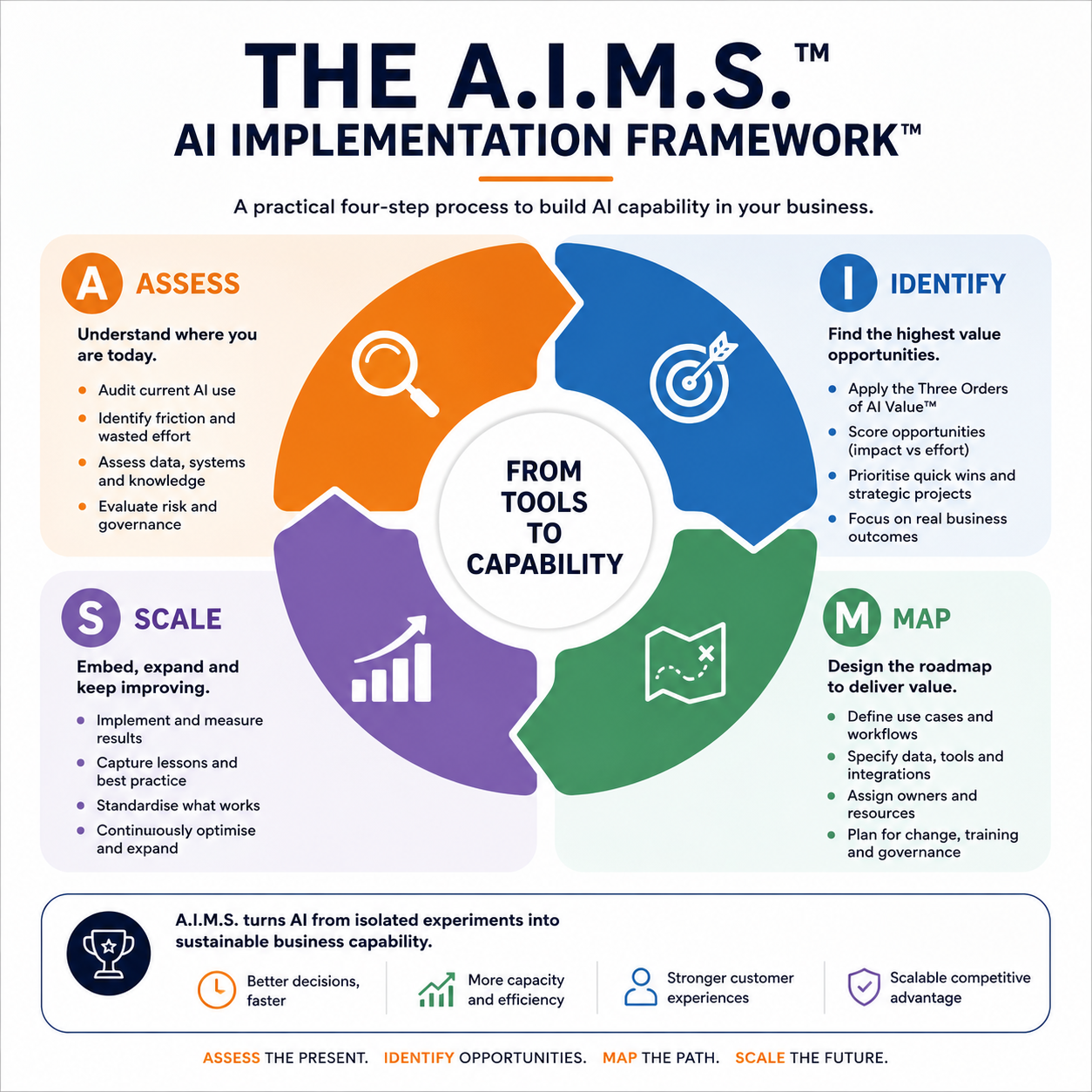
A practical implementation framework. And that’s exactly what the A.I.M.S. Framework is designed to provide.
6. The A.I.M.S. AI Implementation Framework
So far, I’ve deliberately concentrated on why businesses need to approach AI differently. But eventually strategy has to become action. And this is where I think many discussions about AI become unnecessarily complicated.
- A small business doesn’t need a 100-page AI strategy.
- It doesn’t need an AI transformation department.
- It doesn’t need to understand every new model that appears.
And it certainly doesn’t need to implement everything at once. What it does need is a structured way of deciding:
- Where are we now?
- Where could AI create the greatest value?
- What should we implement first?
- How do we turn successful experiments into permanent business capability?
That’s what I’ve designed the A.I.M.S. AI Implementation Framework to do.
A.I.M.S. consists of four stages:
A — Assess
I — Identify
M — Map
S — Scale
The sequence matters. Because one of the biggest mistakes businesses make with AI is starting at the wrong end. They start with the technology. A.I.M.S. starts with the business.
A — Assess: Understand Where You Are Now
Before deciding where AI should take the business, I want to understand where the business is starting from. That means conducting an AI Capability Audit.
And importantly, I’m not simply asking which AI tools the company currently uses. I want to understand how work actually happens.
- What AI is already being used?
- Who is using it?
- What are they using it for?
- Which experiments are working particularly well?
- Which tools are being paid for?
- Where is company or customer information being entered?
- What policies currently exist?
- What knowledge has already been developed?
But I’d go considerably further. I’d also look at the business itself. Where does management time disappear? Which activities consume disproportionate amounts of employee time? Where are the bottlenecks? Where do customers have to wait? Where is information repeatedly entered into different systems? Which reports take too long to produce? Where does work regularly need correcting?
Which activities depend heavily upon one particular person? Where is knowledge trapped? Which decisions repeatedly require senior management involvement? Where does the business struggle to scale?
These questions matter because they move us away from thinking about AI as a collection of tools.
We’re looking for constraints.
If I discover that five different employees are spending a combined 40 hours every month manually assembling information for customer reports, that’s interesting. If the managing director is spending ten hours every week answering operational questions because knowledge isn’t documented, that’s interesting.
If every new customer requires information to be manually transferred between three systems, that’s interesting. If salespeople spend more time researching and preparing proposals than actually speaking to customers, that’s interesting.
Those are potential AI opportunities.
The purpose of Assess isn’t to produce an enormous technology audit. It’s to create a clear picture of: Where are we losing time, capacity, knowledge, money or opportunity?
Once we understand that, we can start deciding where AI might genuinely matter.
I — Identify: Find the Opportunities That Actually Matter
The next stage is where I think businesses need to become much more selective. AI creates an unusual problem. There are almost too many possibilities. Give a management team an hour to brainstorm ways they could use AI and they’ll probably generate dozens of ideas.
That’s not particularly difficult. The difficult part is deciding which ideas deserve attention. Because every AI opportunity competes for something scarce. Management attention. Employee time. Implementation capacity. Money. And organisational energy. So I wouldn’t create a huge list and start working through it. I’d prioritise.
A useful starting question is: Where could AI create the greatest commercial value for the least implementation complexity?
That immediately starts separating interesting demonstrations from useful business applications.
Look for High-Value Friction
I’d start by looking for friction. Tasks that happen frequently. Tasks that take too long. Processes involving large amounts of information. Repeated decision-making. Repetitive communication. Manual data transfer. Knowledge-intensive work. Administrative bottlenecks. Processes that regularly produce errors.
Activities preventing skilled employees from doing more valuable work. These are often fertile areas for AI. But I’d also look for something else.
Leverage.
An activity that saves one employee ten minutes per month probably isn’t where I’d begin. An improvement that saves 20 employees 30 minutes every day might be. Similarly, reducing the time required to produce an internal document may be useful.
But improving the process responsible for converting prospects into customers could have a much greater commercial impact. The objective isn’t to find the cleverest AI application.
It’s to find the most valuable one.
Think Through All Three Orders of Value
This is also where I’d deliberately apply The Three Orders of AI Value.
For every significant opportunity, ask: First order — what task could AI improve?
Then: Second order — what process could we redesign as a result?
And finally: Third order — what new capability could this create for the business?
Take customer enquiries. At first order, AI might help employees write responses faster. Useful. At second order, perhaps AI could analyse the enquiry, identify what the customer wants, retrieve relevant information, prepare a draft response and route it to the right person.
Much better.
At third order, perhaps the business becomes capable of providing highly informed responses to enquiries within minutes rather than hours or days. Now we’ve potentially changed the customer proposition. That’s exactly the sort of opportunity I want the Identify stage to uncover.
Build an AI Opportunity Matrix
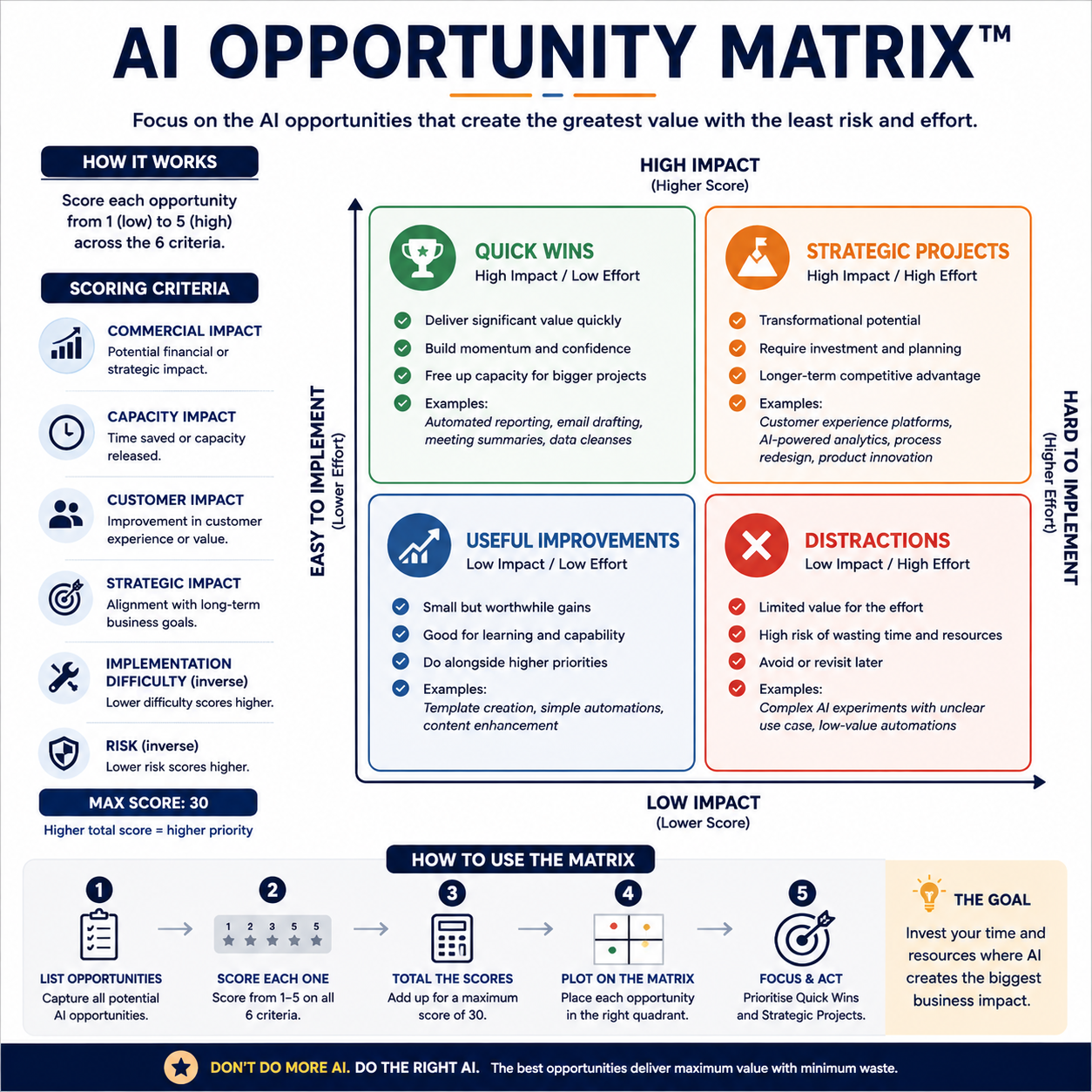
At this point, I’d score potential projects against a small number of criteria. For example:
- Commercial Impact: How much value could this create?
- Time Saving: How much employee or management capacity could it release?
- Customer Impact: Would customers notice the improvement?
- Strategic Impact: Could this create a meaningful new organisational capability?
- Implementation Difficulty: How difficult will it be to introduce?
- Risk: What could go wrong?
This creates a simple AI Opportunity Matrix. And I’d expect opportunities to fall broadly into four categories.
Quick Wins: High value. → Low complexity.→ Do these first.
Strategic Projects: High value. → Higher complexity. → Plan these carefully.
Useful Improvements: Lower value.→ Low complexity.→ Implement when capacity allows.
Distractions: Low value. → High complexity. → Ignore them.
That final category may be one of the most valuable. A good AI strategy shouldn’t simply tell you what to do. It should tell you what not to do.
M — Map: Turn Opportunities Into an Implementation Roadmap
Once we’ve identified the best opportunities, we need to move from possibility to implementation. This is where we build the AI Adoption Plan. And I’d deliberately keep this practical. For each priority project, I’d want to define:
- The problem we’re solving: What currently happens and why does it need improving?
- The desired outcome: What should be different when we’ve finished?
- The AI application: How will AI contribute?
- The workflow: How will the new process actually work?
- The owner: Who is responsible for implementation?
- The technology: Which systems are required?
- The data: What information will the AI need access to?
- The risks: What could go wrong and how will we control it?
- The human role: Where does human judgement remain necessary?
- The success measure: How will we know whether it worked?
- The timetable: When will we test, review and implement it?
Now we’ve moved a long way from: “We should probably do something with AI.” We have an implementation project.
Don’t Try to Transform the Whole Business at Once
This is another area where I think SMEs have an advantage. Large organisations can spend years developing transformation programmes. Small businesses can move much faster.
But only if they remain focused.
I wouldn’t begin with 25 AI projects. I’d probably begin with three.
Perhaps: One quick productivity win.
Something employees can experience immediately. One workflow improvement.
Something that improves how part of the organisation operates. One strategic experiment.
Something exploring a potentially significant new capability. That creates a portfolio.
You’re generating immediate value while simultaneously learning how to implement AI and exploring where the bigger opportunities might exist.
Map the Dependencies
Some projects won’t be possible immediately. And that’s useful information.
- Perhaps the data isn’t good enough.
- Perhaps processes aren’t documented.
- Perhaps two systems need integrating.
- Perhaps employees need training.
- Perhaps information security needs addressing first.
- Perhaps the business doesn’t actually understand its existing process well enough to automate it.
These aren’t reasons to abandon AI. They’re part of the implementation roadmap. In fact, AI may reveal investments the business should probably have made anyway.
- Better data.
- Better documentation.
- Better processes.
- Clearer responsibilities.
- More integrated systems.
Again, AI becomes a catalyst for improving the underlying business.
S — Scale: Turn Successful Experiments Into Business Capability
This final stage is the one I think will ultimately determine who crosses the AI Capability Gap. Because experimenting is relatively easy. Scaling what works is much harder. Suppose an employee discovers an AI workflow that saves them five hours every week.
Excellent. But the implementation isn’t finished.Now I want to know:
- Could other employees use it?
- Can we document it? Can we standardise the prompts?
- Can we integrate it into existing systems?
- Can we automate parts of the workflow?
- Can we train new employees to use it?
- Can we measure the results?
- Could the same principle work elsewhere?
This is how an individual experiment becomes organisational capability.
Capture What Works
Businesses need a mechanism for capturing successful AI applications. That might eventually include an internal AI Playbook containing:
- Approved AI tools.
- Successful prompts.
- Standard workflows.
- Examples of good output.
- Data rules.
- Training materials.
- Known limitations.
- Implementation case studies.
- Lessons learned.
The important thing is that knowledge stops living exclusively inside individual employees. Every successful implementation should make the organisation slightly smarter.
Standardise Before You Scale
There’s also a danger in scaling too quickly. An AI process that works brilliantly for one employee isn’t necessarily ready to become the company standard. It needs testing. Different scenarios need exploring. Errors need identifying. Human controls need defining. Security needs checking. Results need measuring. Only then should we scale it.
The objective isn’t: Use more AI.
The objective is: Scale proven AI capability.
That’s a very different mindset.
Measure, Learn and Improve
Scaling also creates a feedback loop. Implement. Measure. Learn. Improve. Then implement again.
Suppose we introduce AI into a sales process because we believe it will reduce proposal preparation from two hours to 30 minutes. Measure it.
- Did it?
- What happened to proposal quality?
- What happened to conversion rates?
- Did salespeople actually use the process?
- What did customers think?
- Did another bottleneck appear somewhere else?
Perhaps we discover the time saving isn’t the most important result. Maybe faster proposal preparation means prospects receive proposals on the same day rather than three days later. And perhaps that improves conversion.
Suddenly we’ve discovered a second- or third-order effect we didn’t initially anticipate. Measurement allows us to find those effects.
A.I.M.S. Creates a Continuous Cycle
Although I’ve described A.I.M.S. as four stages, I don’t see it as something a business completes once. It’s a cycle.
Assess. Understand the business and its current AI capability.
Identify. Find the highest-value opportunities.
Map. Turn those opportunities into an implementation roadmap.
Scale. Embed what works and build organisational capability.
Then Assess again. Because six months later, the business will have changed. AI will have changed. Employees will have learned. New opportunities will have appeared. Old constraints may have disappeared. New constraints may have emerged. And capabilities that seemed impossible six months earlier may suddenly become practical. That’s why I don’t believe an AI Implementation Strategy should be a static document.
It should become part of how the business improves itself.
The Objective Isn’t AI Adoption
This brings us back to the distinction I’ve been making throughout this article. If we measure success by the number of employees using AI, we’ll optimise for AI usage. If we measure success by the number of AI tools we’ve purchased, we’ll optimise for technology adoption. Neither tells us whether we’ve built a better business. A.I.M.S. deliberately starts and finishes somewhere else.
- It starts with the business.
- Its constraints.
- Its customers.
- Its people.
- Its opportunities.
- Its strategy.
Then it asks where AI can create value. And it finishes by taking what works and embedding it into the organisation.
That’s how we move: From tools to systems. → From experimentation to implementation. → From individual knowledge to organisational knowledge. → From first-order productivity to third-order transformation.
And ultimately: From AI adoption to AI capability.
That’s the real purpose of an AI Implementation Strategy. Not to make sure your business is using AI. But to systematically build a business that is capable of doing things it couldn’t do before.
7. Building an AI Adoption Plan
A strategy tells us where we’re going. An adoption plan tells us what we’re going to do on Monday morning. That’s an important distinction.
The A.I.M.S. Framework gives us the methodology for deciding where AI can create value, which opportunities should be prioritised and how successful implementations become organisational capability.
But somebody still has to turn those decisions into a programme of work. That’s the purpose of the AI Adoption Plan.
And for most SMEs, I think the biggest mistake would be trying to move too quickly. There’s understandable pressure to do exactly that.
AI is developing at an extraordinary pace. Every week seems to bring another major announcement. Competitors are talking about it. Employees want access to new tools. Software providers are adding AI to virtually everything. It creates a feeling that we’re already behind.
That can lead to an understandable response: “We need to get AI implemented across the business.”
I wouldn’t do that. I’d build capability progressively. Because implementing AI isn’t simply a technology rollout. We’re learning how AI interacts with our people, processes, customers, information and decision-making.
We need experience.
And the best way to acquire that experience is through a series of increasingly ambitious implementations. I’d structure the AI Adoption Plan around five phases.
- Phase 1 — Audit : Understand what we’ve already got.
- Phase 2 — Quick Wins: Prove value and build confidence.
- Phase 3 — Department Implementation: Redesign specific areas of the business.
- Phase 4 — Business Integration: Connect AI capabilities across the organisation.
- Phase 5 — Continuous Optimisation: Create a business that continually improves how it uses AI.
Each phase builds upon the one before it. And importantly, we don’t need to know exactly what Phase 5 looks like when we begin Phase 1. We’ll learn our way there.
Phase 1 — Audit: Discover the AI Business You Already Have
The first phase isn’t really about introducing AI. It’s about discovering what’s already happening. In many businesses, I suspect management would be surprised by the amount of AI already being used. So I’d begin with a simple internal audit. Ask employees:
- Which AI tools are you currently using?
- What are you using them for?
- Which applications save you the most time?
- Which prompts or workflows have you developed?
- What would you like AI to help you with?
- What information are you putting into AI systems?
- Are you paying for any AI subscriptions yourself?
This isn’t an investigation designed to catch people doing something wrong. Quite the opposite. We’re looking for good ideas. There may already be some brilliant AI applications hidden inside the organisation.
- Perhaps someone in customer service has developed a prompt that dramatically improves responses.
- Perhaps a salesperson has created a fantastic prospect-research process.
- Perhaps someone in operations is analysing documents in a way that saves hours.
The audit brings those experiments into the open. But I’d combine that with a second audit. A business friction audit.
- Where is time being wasted?
- Where are people waiting?
- Where are customers waiting?
- Where does information get rekeyed?
- Which processes require excessive administration?
- Which reports take too long to prepare?
- Which activities depend heavily upon individual knowledge?
- Where are errors common?
- Where does management become the bottleneck?
- Where do we repeatedly employ skilled people to perform relatively low-value work?
Put the two audits together and we get something useful.
We understand both: Where AI is already creating value.
And: Where AI could potentially create much more value.
That’s our starting position.
Phase 2 — Quick Wins: Prove That AI Can Create Real Value
Now I’d deliberately look for a handful of relatively easy implementations. Not because quick wins represent the ultimate opportunity.
They don’t.
But because organisational change becomes considerably easier when people can see the benefits. Imagine telling employees: “We’re beginning a major AI transformation programme.” Depending upon the person, that could sound exciting.
Or terrifying.
Now imagine showing someone that a repetitive task they hate doing every Friday afternoon can be reduced from two hours to 20 minutes. That’s a very different conversation. They’ve experienced the benefit. So Phase 2 should deliberately create visible success. Good quick wins tend to have several characteristics. They’re relatively easy to implement. They carry limited risk. They occur frequently enough for the benefit to accumulate.
The output is easy to check. And the value is reasonably easy to measure.
Examples might include:
- meeting summaries and action points
- initial document drafting
- internal research
- customer meeting preparation
- summarising lengthy documents
- extracting information from documents
- preparing standard communications
- analysing customer feedback
- generating first drafts of internal reports
- creating training material from existing documentation
The important thing is that we measure the before and after. If a process previously took 90 minutes and now takes 25, record it. If employees were producing ten reports per week and can now produce 20, record it. If customers receive responses in two hours instead of two days, record it. We’re beginning to build an internal evidence base.
AI creates value here.
That matters because evidence changes the nature of the conversation. AI stops being theoretical.
Phase 3 — Department Implementation: Move From Tasks to Workflows
Once we’ve proved that AI can create value, I’d increase the ambition.
Instead of asking: “Which tasks can AI improve?”
I’d choose a department or business function and ask: “How could AI improve the way this entire function operates?”
This is where we start moving firmly into second-order value. Take sales. Don’t simply give salespeople an AI writing tool. Map the sales process.
- Lead generation.
- Qualification.
- Research.
- Initial contact.
- Discovery.
- Proposal.
- Follow-up.
- CRM updates.
- Pipeline review.
- Where are the bottlenecks?
- Where is information lost?
- Where is activity inconsistent?
- Where does administration consume selling time?
Then design AI around the workflow. Do the same with marketing. Or finance. Or customer service. Or operations. Or HR.
For example, an accounts department might move from using AI occasionally to help write commentary towards an integrated workflow where AI assists with analysing results, identifying unusual movements, preparing management commentary, highlighting questions and producing different management summaries.
The objective isn’t to automate the department. It’s to redesign how humans and AI work together. That’s an important distinction. There will be activities where AI should lead. Activities where AI should assist. Activities where humans should review. And activities where human judgement should remain dominant. A good departmental implementation defines those boundaries.
Phase 4 — Business Integration: Connect the Organisation
This is where AI adoption starts becoming genuinely strategic. Up until this point, much of our implementation may still sit within individual business functions.
- Sales has developed AI capability.
- Finance has developed AI capability.
- Marketing has developed AI capability.
- Operations has developed AI capability.
But businesses don’t create value in departmental silos. A customer doesn’t particularly care whether they’re currently dealing with marketing, sales, operations, finance or customer service. They experience one organisation.
So eventually, our AI systems need to reflect that.
Imagine what happens when the information captured during the sales process automatically improves customer onboarding. Customer onboarding improves operational delivery. Operational information feeds management reporting. Customer feedback informs marketing. Financial information influences sales priorities.
Management can interrogate information across the organisation rather than manually assembling it from separate departments. Now we’re beginning to create something much more powerful.
Organisational intelligence.
And this is where data and knowledge become increasingly important. AI is significantly more useful when it understands context.
- Your products.
- Your customers.
- Your processes.
- Your pricing.
- Your policies.
- Your previous decisions.
- Your terminology.
- Your accumulated experience.
- Your way of doing business.
The strategic challenge therefore begins shifting from simply accessing AI towards building an organisational knowledge environment that AI can work with. This is one of the areas where I think some of the biggest long-term competitive advantages will emerge. Because everyone may have access to similar AI models.
They won’t have access to your accumulated organisational knowledge.
Phase 5 — Continuous Optimisation: Build a Business That Learns
There isn’t really an end point to AI implementation. And I think that’s important to recognise from the beginning. If we create an AI strategy today and expect it to remain unchanged for five years, it will probably be obsolete long before then. The technology is changing too quickly. But our business is changing too.
That’s why the final phase isn’t: AI Implementation Complete.
It’s: Continuous Optimisation.
At this stage, AI improvement becomes part of normal management. Perhaps every quarter we ask:
- What have we implemented?
- What worked?
- What didn’t?
- What value did we create?
- What have employees discovered?
- Which new AI capabilities have emerged?
- Which processes should we revisit?
- Where are the new constraints?
- Which successful applications should we scale?
- Which tools should we stop using?
- Where is the next third-order opportunity?
Now AI isn’t a special project anymore. It’s part of continuous business improvement. And this is where the compounding effect we discussed earlier becomes particularly powerful. Each implementation teaches us something. That learning improves the next implementation.
- Our data improves.
- Our prompts improve.
- Our workflows improve.
- Our employees improve.
- Our judgement about where AI works improves.
- Our ability to implement AI improves.
The business becomes better at becoming better. That’s an extraordinarily valuable capability.
Don’t Measure the Plan by the Number of AI Projects
There’s one final point I’d make about the AI Adoption Plan. I wouldn’t create a target such as:
“Implement 20 AI applications this year.”
That risks turning AI adoption into a numbers game. Twenty mediocre implementations aren’t necessarily better than three transformational ones. Instead, I’d build a simple AI Implementation Scorecard around outcomes. For example:
Capacity Created: How many hours of employee or management capacity have we released?
Financial Value: What cost has been removed, avoided or redirected?
Revenue Impact: Has AI helped generate, protect or accelerate revenue?
Customer Impact: Have response times, service quality or customer outcomes improved?
Quality: Have errors fallen or consistency improved?
Capability: What can the organisation now do that it couldn’t do before?
That final measure is particularly important. Because if we return to The Three Orders of AI Value, our ultimate objective isn’t simply to save hours. It’s to change what the organisation is capable of.
From a 90-Day Plan to a Long-Term Capability
For a small business starting today, I’d probably turn the first two phases into an initial 90-Day AI Adoption Plan.
Days 1–30: Understand
Audit current AI use. Map business friction. Identify risks. Establish basic governance. Create the AI Opportunity Matrix. Select the first projects.
Days 31–60: Experiment
Implement the first quick wins. Train the relevant employees. Measure the results. Capture successful prompts and workflows. Identify what needs improving.
Days 61–90: Embed
Standardise what worked. Document the processes. Build them into normal workflows.Share the learning.Select the first departmental implementation. Agree the next 90-day priorities.
At the end of 90 days, I wouldn’t expect the business to be “AI transformed”. That isn’t the objective. I’d expect something much more valuable. The business should know where it stands.
- It should have basic governance.
- It should have identified its highest-value opportunities.
- It should have implemented several useful applications.
- It should have measured some real commercial value.
- It should have started capturing organisational AI knowledge.
And it should know what it’s doing next. In other words, instead of AI developing randomly throughout the organisation, the business now has direction.
That’s the point at which an AI Implementation Strategy stops being a document. It becomes a management process. And that’s how we begin systematically closing The AI Capability Gap.
8. Governance Creates Capability
Whenever I mention AI governance to a small business owner, I can almost hear the enthusiasm disappearing. Governance sounds corporate.
- Policies.
- Committees.
- Rules.
- Restrictions.
Another layer of bureaucracy getting between people and the work they’re trying to do. But I think that’s the wrong way to think about it.
“Good AI governance isn’t about controlling AI. It’s about creating the conditions that allow us to use it more effectively.”
And for most SMEs, it doesn’t need to be particularly complicated.
The Problem With Having No Rules
Without some basic governance, all the problems we’ve discussed earlier begin to accumulate. Employees choose different tools. Different departments solve the same problem independently. Company information gets entered into systems without anyone considering the implications.
The quality of AI-generated work varies dramatically between employees. Successful prompts and workflows remain with individuals. Nobody knows which outputs need human checking. And nobody is quite sure who is responsible when something goes wrong.
The business may be using more AI. But it isn’t necessarily developing more capability. In fact, the lack of structure can actively prevent that capability from developing.
Create Guardrails, Not Roadblocks
I think the objective should be to create guardrails rather than roadblocks. Employees need some simple answers.
- Which AI tools are approved?
- What information can we put into them?
- What information must never be entered?
- When does AI-generated work require human review?
- Which activities shouldn’t be delegated to AI?
- Who approves new AI applications?
- Where do we record useful prompts, workflows and discoveries?
- Who is responsible for making sure successful experiments are shared?
These don’t require a 50-page AI policy. For many small businesses, they could probably be covered initially in a few pages. The important thing is that people understand the boundaries. And paradoxically, that can actually encourage experimentation.
If I know what I’m allowed to do, what I’m not allowed to do and where the risks lie, I can experiment with considerably more confidence.
Governance Turns Individual Learning Into Organisational Learning
But I think governance has a second purpose that’s potentially even more important. It creates a mechanism for capturing what the business learns. Imagine ten employees are experimenting with AI. Without any structure, you potentially have ten separate learning curves.
- Each person discovers what works.
- Each person makes mistakes.
- Each person develops prompts.
- Each person finds useful applications.
But very little of that learning necessarily travels between them. Now introduce a simple process. When somebody discovers a particularly valuable AI application, they record it. The business tests it.
- The workflow is refined.
- The prompt is documented.
- The risks are considered.
- The results are measured.
- Other employees are trained.
The application becomes part of the normal process.
Now those ten individual learning curves start becoming one organisational learning curve. That’s a very different proposition.
Build an AI Playbook
Over time, I’d expect this to develop into a simple internal AI Playbook.
It might contain:
- approved AI tools
- company AI policies
- standard prompts
- proven workflows
- examples of good outputs
- known limitations
- data and security rules
- human review requirements
- lessons from previous implementations
- training material
The playbook doesn’t need to be static. In fact, it shouldn’t be. Every successful AI implementation should add something to it. Every mistake should teach us something. Every new workflow should improve the organisation’s collective knowledge. And this connects directly to the AI Capability Gap. A competitor can buy the same AI software tomorrow.
They can’t instantly buy the accumulated knowledge you’ve developed about how to use it inside your business.
Governance Is an Accelerator
This is why I think we need to change the way we think about AI governance. It isn’t simply a defensive exercise designed to prevent employees doing something stupid. Of course, security, confidentiality, accuracy and accountability matter. But governance also has an offensive purpose. It allows us to:
- Experiment safely.
- Capture what works.
- Standardise successful approaches.
- Share knowledge.
- Scale proven systems.
- Continuously improve them.
That’s how individual AI usage becomes organisational AI capability.
So rather than asking: “How do we control the use of AI?”
I’d ask a better question: “How do we create enough structure that every successful AI experiment makes the whole business smarter?”
Because ultimately, good governance doesn’t restrict AI capability. It compounds it.
9. AI Is Not an IT Project
One of the easiest mistakes a business can make is to classify AI as an IT project. I understand why. AI is technology.
It involves software, data, integrations and systems. There will inevitably be technical decisions to make, and IT specialists will have an important role in making them. But AI implementation is too important to be delegated to IT.
The reason is simple. The most important questions aren’t technical questions. They’re business questions.
- Should AI change how we price?
- Could it change how we serve customers?
- Could it allow us to operate with a different cost structure?
- Which decisions could be made faster?
- Which processes should disappear altogether?
- Where could management capacity be released?
- Could we create services that weren’t previously economically viable?
- How might AI change what customers expect from us?
- Could it change where our competitive advantage comes from?
These are questions about the future shape of the business. And that’s a leadership responsibility.
The Wrong Question
If AI is treated primarily as a technology project, the conversation naturally starts with: “What technology should we implement?” I think leadership needs to start somewhere else: “What kind of business could AI allow us to build?”
Technology comes afterwards. That subtle change in question moves the conversation from software selection to business design. And that’s where the real opportunity lies. Because AI could ultimately influence almost every important component of a business:
- How we make decisions.
- How we organise work.
- How we price.
- How we communicate with customers.
- How we manage knowledge.
- How we operate.
- How we scale.
- How we compete.
Those decisions can’t be made by an IT department in isolation.
Leadership Doesn’t Need to Become Technical
This doesn’t mean every managing director needs to become an AI expert. I don’t think they do. A business leader doesn’t need to understand exactly how a large language model works any more than they need to understand the engineering behind cloud computing.
But they do need to understand what the technology makes possible.
- Enough to ask better questions.
- Enough to challenge existing assumptions.
- Enough to recognise opportunities.
- Enough to make sensible investment decisions.
And enough to establish where AI fits within the wider business strategy. Technical specialists can then help determine how those ambitions are delivered. That’s the right relationship.
- Leadership determines the destination.
- Technology helps build the route.
AI may be powered by technology. But implementing it successfully is ultimately an exercise in organisational transformation.
And organisational transformation belongs in the boardroom, not the server room.
10. Build Capability Before It Becomes Your Competitive Advantage
There is a temptation to believe that because AI is developing so quickly, the sensible strategy is to wait.
- Wait for the technology to mature.
- Wait for the winners to emerge.
- Wait until implementation becomes easier.
- Wait until we can see what everyone else does.
In some areas, that makes perfect sense. I certainly wouldn’t recommend chasing every new AI tool that appears. But there’s a problem with waiting.
“The technology can be acquired quickly. Capability cannot.”
Capability Takes Time to Build
You can buy access to an AI system this afternoon. You can’t instantly create the experience required to use it effectively across an organisation. That comes from experimentation. Implementation. Mistakes. Training. Process redesign. Captured knowledge. Measurement. And hundreds of small improvements accumulated over time.
This creates an important strategic progression. Today, AI capability creates efficiency.
Businesses use it to save time, reduce administration and increase capacity.
Tomorrow, AI capability creates competitive advantage.
Some businesses begin operating faster, serving customers better, making better decisions and scaling more efficiently than their competitors. Eventually, AI capability can become a barrier to entry. Not because competitors can’t access the technology.
But because they can’t instantly replicate the systems, knowledge, data, workflows and organisational learning that have been built around it.
The Gap Can Compound
This brings us back to The AI Capability Gap.
Imagine one business starts systematically building AI capability today while a competitor waits three years. Three years from now, the competitor can buy exactly the same AI technology. But it can’t buy the three years of learning. Meanwhile, the first business hasn’t stopped.
- It’s still learning.
- Still improving.
- Still integrating.
- Still building.
The competitor isn’t chasing a stationary target. It’s chasing something that’s continuing to move. That’s why I think the strategic question isn’t whether businesses should rush into AI.
They shouldn’t.
It’s whether they should start learning how to implement AI effectively. And I think the answer to that is much clearer. The best time to build AI capability is before you desperately need it. Because once that capability becomes a significant source of competitive advantage within your industry, you may discover that simply buying the technology is no longer enough to close the gap.
Final word — The AI Capability Gap™ Is Already Opening
I don’t believe the AI revolution will ultimately divide businesses into those that use AI and those that don’t. That distinction won’t last very long.
AI is being built into almost every major business platform. It will sit inside our accounting software, CRM systems, email, spreadsheets, search engines, productivity tools and industry-specific applications.
Before long, saying “we use AI” will be about as remarkable as saying “we use the internet.”
Almost everyone will.
The much more important distinction will be between two very different types of organisation. Those that collect AI tools. And: Those that build AI capability.
The first group will undoubtedly benefit. Their employees will write emails faster. Documents will take less time to produce. Meetings will be summarised automatically. Research will become easier. Administration will reduce. They’ll become more productive.
But much of that advantage will disappear as the same tools become available to everybody else. The second group will go much further.
They’ll redesign processes. Connect information. Capture organisational knowledge. Remove bottlenecks. Improve decision-making. Build new workflows. Change how customers are served. Increase management capacity. Develop new operating models. And potentially create entirely new products, services and ways of competing.
They won’t simply use AI to make the existing business faster. They’ll use AI to build a different business.
The Real AI Race
That’s why I think we’re focusing on the wrong race. The race isn’t to adopt AI first. It isn’t to buy the most sophisticated technology. And it certainly isn’t to accumulate the largest collection of AI subscriptions. The real race is to learn.
- Which organisations can identify valuable applications fastest?
- Which can turn experiments into repeatable processes?
- Which can capture what their people discover?
- Which can successfully redesign workflows?
- Which can measure what works?
- Which can turn individual learning into organisational learning?
And then do it again. And again. And again.
Because every time that happens, the organisation becomes slightly more capable. That’s how The AI Capability Gap begins to open.
Initially, the difference may be almost invisible. One business saves a few more hours than another. But then those hours become capacity. That capacity enables process improvement.
- Better processes create better information.
- Better information improves decisions.
- Better decisions improve performance.
Successful systems get scaled. Knowledge accumulates. Capability compounds. Eventually, what started as a relatively small difference in AI adoption can become a significant difference in how two competing businesses operate.
Don’t Build an AI Strategy. Build a Better Business.
Ultimately, though, I don’t think the objective should be to become an “AI business”. That puts the technology at the centre of the strategy. The objective should be much simpler. Build a better business.
- A business that makes better decisions.
- A business that responds faster.
- A business that wastes less time.
- A business that captures its knowledge.
- A business that isn’t unnecessarily dependent upon individuals.
- A business that can grow without costs increasing at exactly the same rate.
- A business that provides a better customer experience.
- A business that continually learns and improves.
AI is simply an extraordinarily powerful new capability that can help us build that business. That’s why we need to move beyond random adoption and start implementing AI deliberately. Assess where you are. Identify where the greatest opportunities exist. Map how you’re going to implement them. Scale what works. Then repeat.
- Don’t try to implement everything.
- Don’t chase every new tool.
- Don’t automate something simply because you can.
But do start.
Because the businesses that develop the greatest AI capability over the next few years won’t necessarily be the businesses with the biggest budgets or the most sophisticated technology.
They’ll be the businesses that learn how to turn AI into better systems, better decisions and better ways of working. And while everyone else is still collecting tools, they’ll be building something much harder to copy.
Capability.
That is The AI Capability Gap. And it’s already beginning to widen.